Stats for percentage canditates passing all 6 divisions from 1st try

Just having some fun looking up pass rates for various exams, but not able to find stats for percentage of folks who passed all 6 divisions from the first try, seems like an interesting bit of information...
-

Below is a table from the most recent NCARB By the Numbers for first-time pass rates for each division. With this information, we can calculate that approximately 6% of candidates pass all six divisions on their first try.
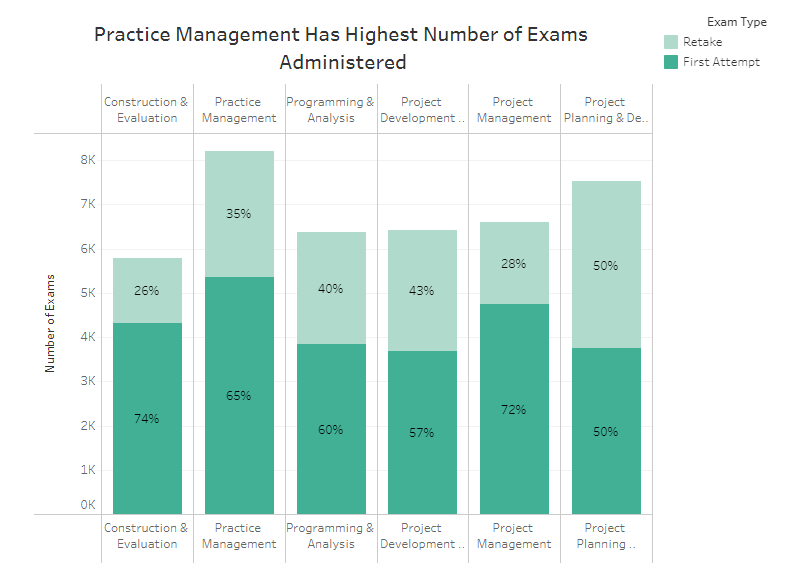
This can be calculated by multiplying (0.74 x 0.65 x 0.60 x 0.57 x 0.72 x 0.50) = 0.0592 = 6%
-
I'm not great at calc'ing out probabilities - this seems like it would work for probability for random independent events, but how do you know that the same 50% of people were not the same people that passed all the other exams also? It'd expect something more in 30s or 40s since even anecdotally, out of all architects I know, much more than 6% passed all tests from the first try...
-
Look up multiplication rule probability / general multiplication rule.
Each exam division is an independent event; the dark green indicates the pass rates of first-time test-takers, regardless of the order that the divisions may have been taken or whether or not they have completed the process. Remember that these numbers include all test-takers across the world.
Take PcM and PjM, for example. For individuals taking the divisions for the first time, the likelihood of passing PcM is 65%, and PjM is 72%. Therefore, the likelihood of a person passing both on the first attempt is the product of those probabilities: 0.65 x 0.72 = 0.468 = 47%.
Now, if you want to include the probability of also passing CE, you multiply 0.47 x 0.74 = 0.346 = 35%
-
Appreciate it, but I don't think this is an appropriate application of probability - you'd have to reconcile number of people who passed all the tests vs those either just going through it or those who abandoned the program... best way to reconcile the numbers is through the actual info.
-
Perhaps I misunderstood your question. Asking 'what is the probability of passing all six ARE divisions on the first try' is not the same thing as asking 'of those who have completed the ARE, what percentage passed all six divisions on their first try.' My explanation answers the former. I'm not sure that NCARB provides the data for the latter, but I could be wrong.
It should also be considered that it takes the average candidate 2.7 years to complete all six divisions, and this data is only from the 2021 calendar year. I believe it'd require data from a number of years (along with narrowing it down to only those who completed all six divisions) to find your answer.
-

The probability of passing all 6 exams on the 1st try is very low, less than 3% of candidates pass all the AREs on the first try. 3 of the exams have pass rates of about 50% or less. The highest pass rate is for PjM 63% and PPD at 47% is the lowest. See NCARB's data here: https://www.ncarb.org/pass-the-are/pass-rates
I have only met 1 person who passed all 5 (they did a 5 exam plan) on the 1st try. Many folks don't like to talk about their failures though, especially after passing. I failed PPD and PDD each once. (So I took 8 exams total). I think the failures actually helped me write content. After failing PDD I knew the study resource I used was inadequate. If you are failing repeatedly, you need to study more sources/topics, to study more hours and/or buy new materials, and get help. Switch things up!!
Hope this helps!
Rebekka O'Melia, Registered Architect, NCARB, B. Arch, M. Ed, Step UP, Step UP ARE 5.0 Courses
-

Kirill, you are onto something…the event that the SAME PERSON passes all six exams the first time isn’t equal to likelihood of independent passes in a equal population because there may be something in that person’s experience, focus, memory, study habits, etc that make that one person more or less likely than average to pass any of these exam divisions….think of it like this…the likelihood of rolling two six sided dice and landing on snake eyes (two ones) sits at 1/36….but take the next six people you see and run them in two “different” track events, the 100 meter and the 200 meter dashes. No one would be surprised if the same person won both races. The probability that one person would win both races is far higher than one out of 36….even though the probability of blindly guessing the lane that will win each race is still one out of six….and indeed, NCARB’s VP for examination confirmed for me two years ago that there is a “higher than the pass rates would lead you to believe “ cohort that passes all six on the first try, and similarly, there’s another cohort that accounts for a disproportionate fraction of failed exams so that the average pass rate works out to what it is at about 55% in aggregate. I, myself, have been guilty of over simplifying by multiplying probabilities as if passing the next exam had no correlation with performance on the last one…kind of as a shorthand because I didn’t feel like getting into the weeds, but that’s not really how it works when you look under the hood and I’m glad you got into the weeds.
-
NCARB doesn’t publish the pass rates for the first attempt for the exams. Their pass rates include retakes. It’s a simple math problem. .62 x .63 x .53 x .52 x .47 x .53 = .026
Those pass rate include people retaking the exams. So if approximately 30% of the people are retaking exams, then the pass rate is between 1 and 2%. But some of the people included in those numbers were retaking it for the third time or more. So that pushes the pass rate down below the 1%.Like I said, I do know one person that passed all five on the first try. But I’ve never met anyone else who has. And NCARB loves to publish articles about people who study all day and pass all the exams on the first try, but the reality is they are as rare as a purple unicorn.
Keep studying and good luck! -
Rebekka, NCARB did publish that data in the most recent By the Numbers. See the table above. When isolated to first-time test-takers, the probability of passing all six divisions, without fail, is 6%. That'd be approximately 1 in 20 candidates worldwide, on average.
But for reasons stated previously, I don't believe this single figure addresses the spirit of Kirill's question. The answer to what he asked is likely a higher figure. It sounds like the same question, but it's really not...and I didn't realize that at first.
-
Thanks for all the input, just was curious what type of thought was out there on the subject... I did happen to get each of the 6 green squares from the first try (mainly because I'm too cheap and couldn't stand the thought of paying any more money for the exams) and I also know a few folks who did the same, hence the yearning for one last bit of useless information...
-
I hadn't seen this new data! Thanks!
Wow, this is a lot of info! I will sink my teeth info this more later.
According to this chart the (darker green bars) represent the pass rate on the first attempt. Multiplying those out equals 4%. .65 x. 54 x .59 x .59 x .66 x .50 = 4%

In any case, it's grim... Only 4% pass on the first try!! As an educator, I find it strange that the pass rate for second attempts is LOWER across the board than 1st attempts. So it's a different exam??
And the #s indicate it's taking LONGER to pass the ARE. 2.7 years?! I personally think that these 6 exams could easily be condensed down to 3 exams.
The average passing age is 32 yrs old for the ARE. Many folks have children around that age if they're so inclined. And if you don't complete the ARE before having children, it's SO MUCH MORE DIFFICULT. It's seems so unfair.
This is why I do what I do... Thanks for posting the link.
Rebekka O'Melia, Registered Architect, NCARB, B. Arch, M. Ed, Step UP, Step UP ARE 5.0 Courses
-

I know this is a few years old but I was curious and stumbled across this thread.
I'm curious why the information between the image provided by Rebekka and that by Brett show different pass rate percentages.
To climb into this rabbit hole a little, while it would be interesting to see a specific number on candidates that pass the 6 exams on the first try I feel you'd always be limited to just the probability, especially with the removal of the rolling clock and reinstating old exams from the prior exam versions.
Allowing the credit from past exams give prior exam candidates the ability to take as little as 5 exams with the restructuring of information in 5.0 but could also be as many as 7, depending on which exams were taken in 4.0.
As time flies, it's almost been 10 years since but I was able to pass the 7 exams in 4.0 on the first attempt. The sequence I started in 4.0 didn't benefit me in transitioning to 5.0 as I believe I would have ended up taking the 7 exams mentioned above.
The information that I was actually looking for was the probability of passing the 6 exams but it really is making me think if there's a way to extract this information and it would seem that only NCARB would be able to provide that information.
Thanks all for the interesting discussion.
Please sign in to leave a comment.
Comments
12 comments