NCARB Demo PPD Section 3 - sample Item 6

I have been searching if anyone posting this question before. Perhaps I missed it if someone can point me the link, I appreciate it.
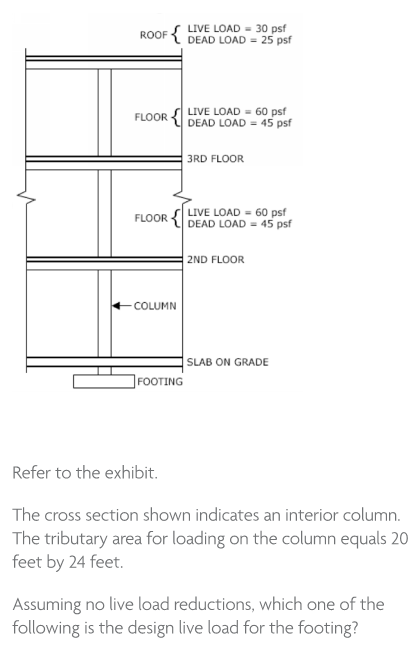
I don't understand why they do not include the load between 2nd floor and Slab on grade?
Thanks in Advance.
-
-

Helena, let's answer your question "what if it's a slab over a crawlspace" with a question. . . .
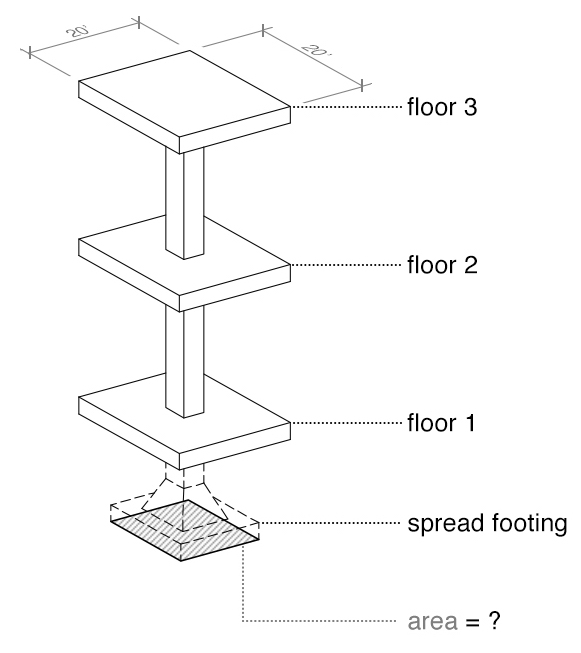
An architect has been hired to design a two-story office building with an occupiable roof as a third story. The first floor sits over a crawlspace. Per the diagram above, each floor of the three-story building is subjected to a combined live + dead load of 100 lbs/sq ft, evenly distributed. (Assume that this load includes the self-weight of the floor and a safety factor.) Each column weighs 2000 lbs per floor and has a tributary area of 20’ by 20’.”
Given that the soil bearing capacity is 4 tons/sq ft, the minimum area of the spread footing will be _______ square feet. (Ignore the weight of the foundation itself.)
Scroll down for the answer. . .
A: 15.5 sq ft
Explanation
Area of each floor: 20’ x 20’ = 400 sq ft
Load from each floor: 400 sq ft x 100 lbs/sq ft = 40,000 lbs
Times three floors: 40,000 lbs x 3 = 120,000 lbs
Plus the weight of two columns for a total load: 120,000 lbs + 2 x 2000 lbs per one-floor column = 124,000 lbs total load at foundation
Soil capacity converted to pounds: 4 tons/sq ft *2,000 lbs/ton = 8,000 lbs/sq ft
Each square foot of soil can support 8,000 lbs, and our column brings down 124,000 pounds, so . . .
Minimum area of the footing: 124,000 lbs / 8,000 lbs/sq ft = 15.5 sq ft
*Important, had the first floor been slab-on-grade, like the NCARB Demonstration Exam you asked about (instead of suspended over a crawlspace) the weight of the first floor would not have been in-play for this calculation.
To watch me solve this in a video, see here. The implosion documentary referenced in the video can be seen <<here>>.


Please sign in to leave a comment.
Comments
7 comments