sound transmission/insulation

Hello All,
The below is a question from the BCPM & Systems (Mehta, 3rd Edition), Chapter 8.
And I thought the answer was (a.) True, however the review answer indicates (b.) False as the correct answer. How is that?, I thought dense materials are better sound barriers, can someone help me with these?
8. Compared to a lightweight building element, a heavyweight element
is generally a poor transmitter of airborne sound.
a. True b. False
-

I have the same question...
In my notes I have:
CMU cells with air are better insulators than grout-filled, but obviously weaker than grout-filed reinforced block. Loose granular mineral poured into the CMU cavities for increased thermal resistance, increased sound transmission loss, and improved fire rating.
And in the NCARD practice exam we have:
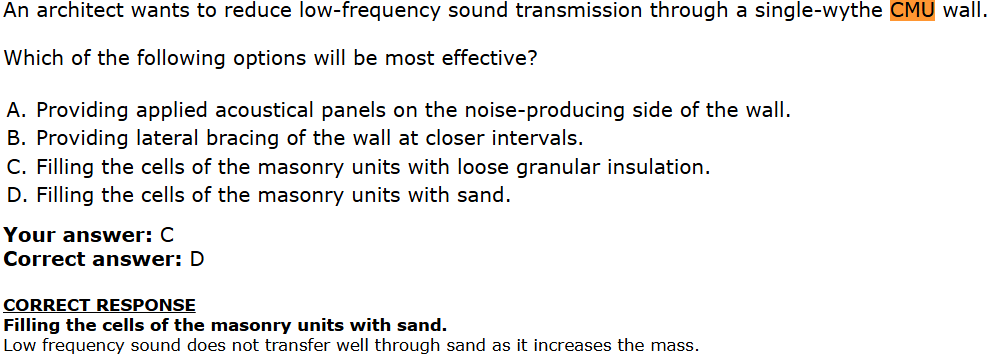
I'm confused. :/
-

When thinking about the weather, there are (mostly) independent variables:
Warm or cold
Windy or still
Sunny or cloudyYou can take a walk on a warm, windy cloudy day…or a cold, windy, cloudy day…or a cold, sunny, still day..
Likewise with architectural acoustics:
Reverberant or dry (can I make out your words in the university lecture room?…sound absorption, fluffy lightweight surfaces, absorption coefficient and NRC)
Has (almost) nothing to do with sound isolation (can I hear the music from your stereo? …Massive, airtight, structurally redundant assemblies. TL, STC)
Has (almost) nothing to do with impact noise (can I hear you walking on the floor above my apartment?…squishy assemblies….IIC)
Has (almost) nothing to do with noise control (How loud is the HVAC system? ….silencers, duct length, quiet equipment, dBA, NC)
Has (almost)t nothing to do with environmental noise
Has (almost) nothing to do with A/V design
Has (almost) nothing to do with speech privacy.
And so on.
So an assembly may create a room that is
Good for lecture halls, robust for stereos, and bad for footfall
Or
Good for lecture halls, poor for stereos, bad for footfall
Or any combination, just like weather.Fluffy materials don’t make (much of) a difference in airborne sound isolation (the stereo next door). Hang a fluffy, sound absorbent curtain between you, on one side, and my stereo, on the other…and you’ll still be annoyed by my music.
—Michael Ermsnn
Amber Book Creator
Author of Architectural Acoustics Illustrated
Please sign in to leave a comment.
Comments
5 comments