What's your response to this Question? Based on left snip I say (a) but Copilot says (d)


-

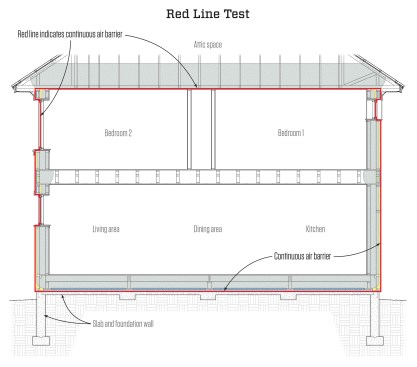
In building construction and assemblies, you're seeing the air barrier in the context of a wall assembly, typically. Consider the language of the question of "generally" the conditions that would require an air barrier. It deals with the exterior, which would eliminate the ceiling, and therefore all of the above, as well.
-

Sarameri,
Because air barriers are often also vapor barriers, you usually want to be careful about having two parallel air barriers in a building section - so you wouldn't typically do both roof and ceiling, for example. That said, as kdegregorio noted, you really want the air barrier to be continuous all the way around your conditioned space. The ceiling is the more common place to put your air barrier; if you don't have one in the ceiling, you likely need one in the roof. Taped gypsum board with sealed penetrations is a very good air barrier that is not also a vapor barrier so long as your interior finishes are vapor-open, and it goes on the interior of your walls and on your ceiling.
What resource is your left screenshot from?
Best,
Ralph, the Amber Book Team -
Sarameri,
It's a good resource, but it's not one of NCARB's official references. I'm not going to say Mehta isn't correct there, because for a relatively large-volume building with a flat membrane roof, it may well be correct because the membrane roof will be an air barrier anyway, but the text is not correct for all building types - mermann describes a condition where the ceiling is by far the leakiest component (at least in summer). That question isn't very well-written - it misses the nuance of building type and it's not really testing for the actual thing you need to know, which is that air barriers should (generally) be continuous - as kdegregorio shows.
Best,
Ralph, the Amber Book Team



Please sign in to leave a comment.
Comments
8 comments