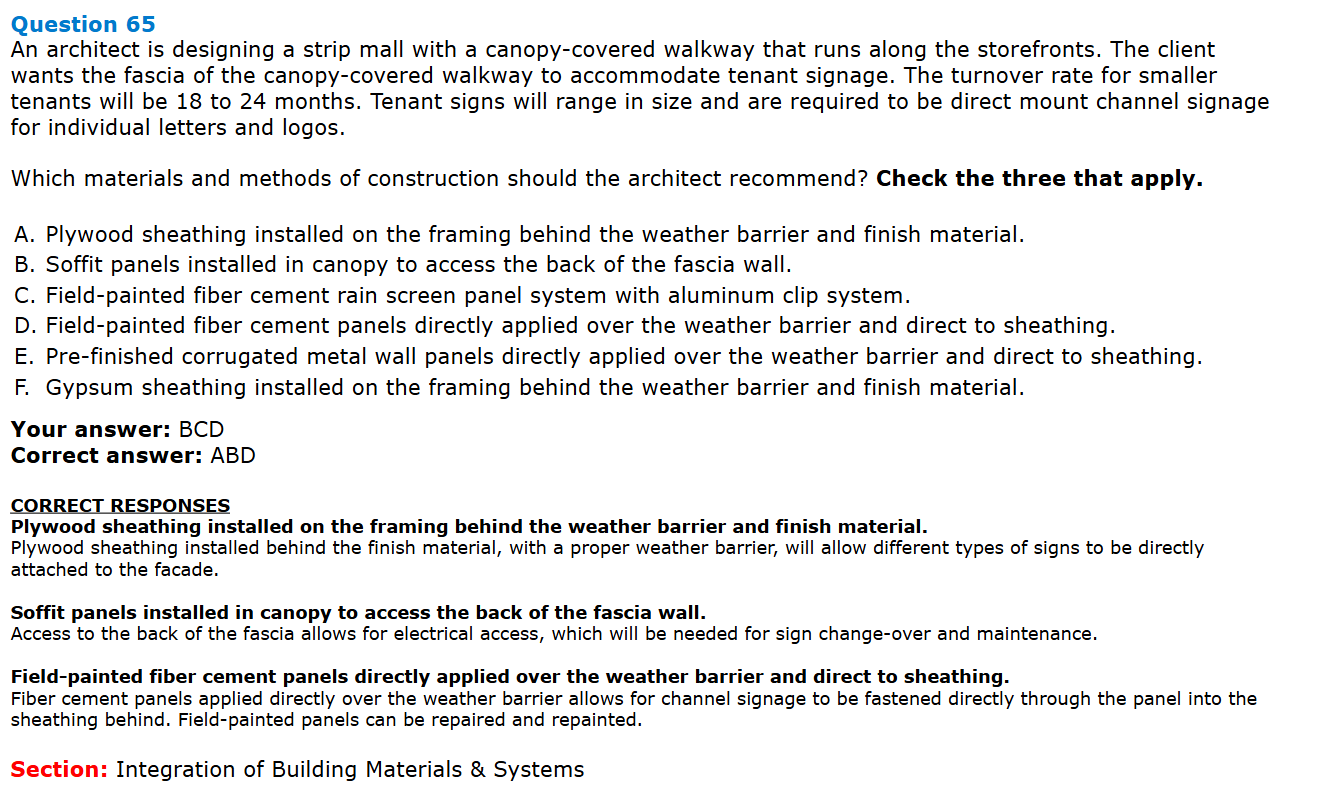
PDD Practice Exam - Q 65

Can anyone explain what we are even talking about in this question? I guess I thought we were being asked to offer three different options, but maybe these are all supposed to work together. I honestly just guessed because I don't understand what kind of construction we are even talking about. Any ideas what they mean by canopy-covered walkway signage?? Is there an example of a wall section you know of to reference to see what we are even discussing? I also don't understand why anything would go under weatherproofing, because you would need to penetrate it. This question is really stumping me.
-

First, they want you to understand that tenants are only expected to occupy the space for 1.5-2years at a time before a new tenant comes in, so know that right off, you need to consider frequent sign swapping.
A. Plywood sheathing behind the weather barrier and finish.
Direct-mounted channel letters and logos need reliable structural backing because each tenant’s sign will have different attachment locations. The plywood provides continuous attachment anywhere along the fascia, better screw withdrawal resistance than gypsum sheathing, and substrate flexibility for swapping signs out often (remember, every 1.5-2years). Proper flashing is still required through the exterior finish AND weather barrier.B. Removable soffit panels for access behind the fascia.
Channel letters are normally illuminated and require electrical wiring, transformers or power supplies, junction boxes, and service access. High tenant change-over means that if you allow access behind the fascia, it allows workers to install/remove wiring, reach the connections behind the sign for install and service while not affecting the front fascia, potentially compromising its finish.D. Field-painted fiber-cement panels directly applied over the weather barrier and sheathing.
A directly applied, field-painted fiber-cement finish is practical for frequent tenant turnover, so when a sign is removed, damaged areas and old fastener holes can be patched, and entire fascias can be replaced and painted in the field to match the paint already existing rather than having it factory-finished (where it may not match).
Cross-section: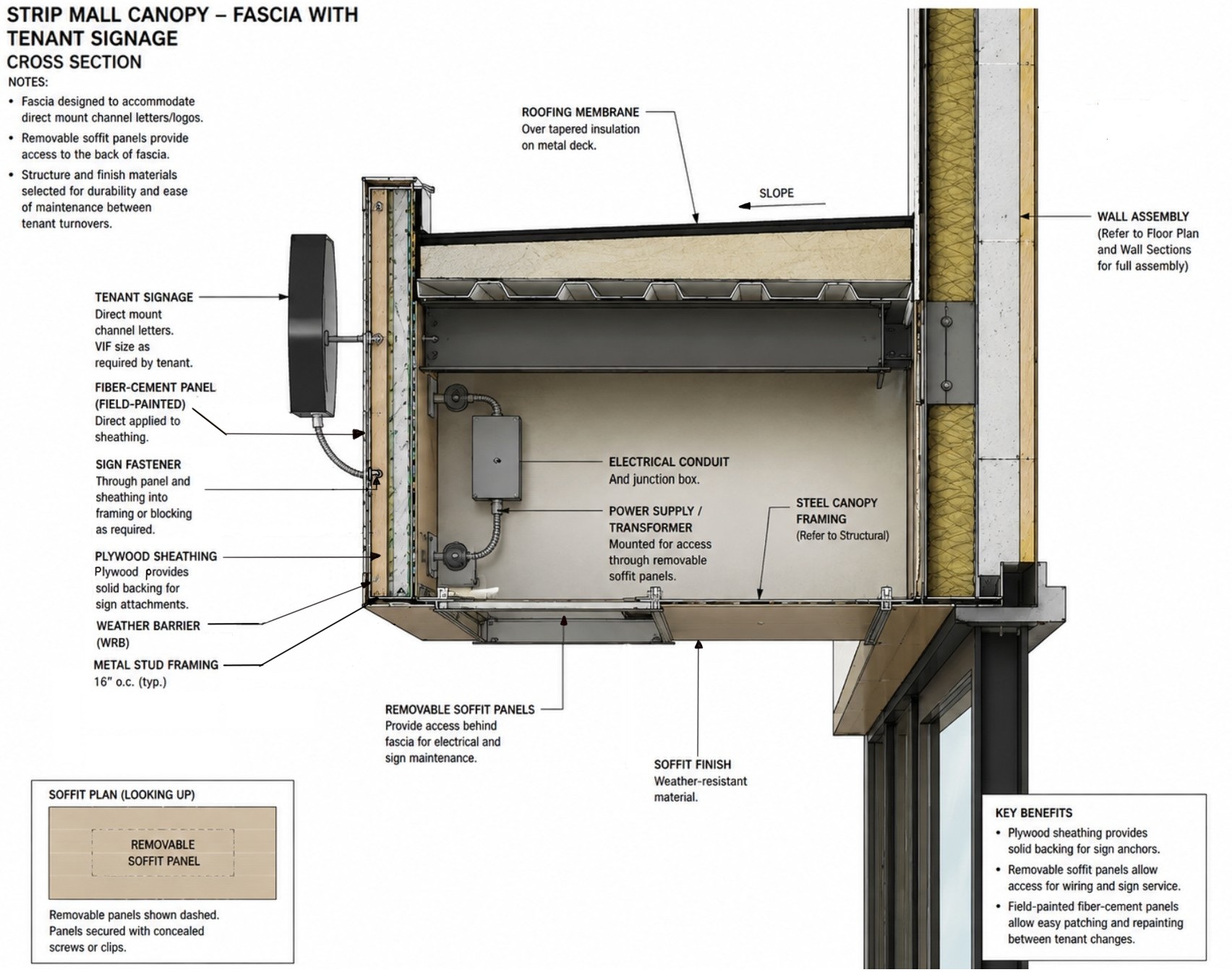
Edit: why the other answers don't apply:
C. Fiber-cement rainscreen with aluminum clips: The cavity and clip system can complicate sign attachment. Fasteners may crush or deflect the panels unless attachments are carefully coordinated with girts or framing. Removing signs may also damage panels or concealed clips.
E. Prefinished corrugated metal panels: Corrugations make direct-mounted individual letters difficult to level and seal (think about water getting behind the vertical corrugations). Abandoned penetrations are conspicuous, and factory finishes are difficult to patch or field-match after repeated tenant changes.
F. Gypsum sheathing: Exterior gypsum sheathing can serve as part of an exterior wall assembly, but it is not dependable structural backing for repeatedly relocated signage, as it can tear apart easily. Sign fasteners would still need a solid substrate attachment.

Please sign in to leave a comment.
Comments
4 comments