NCARB PA 61

Can anyone please explain the reasoning behind this question?
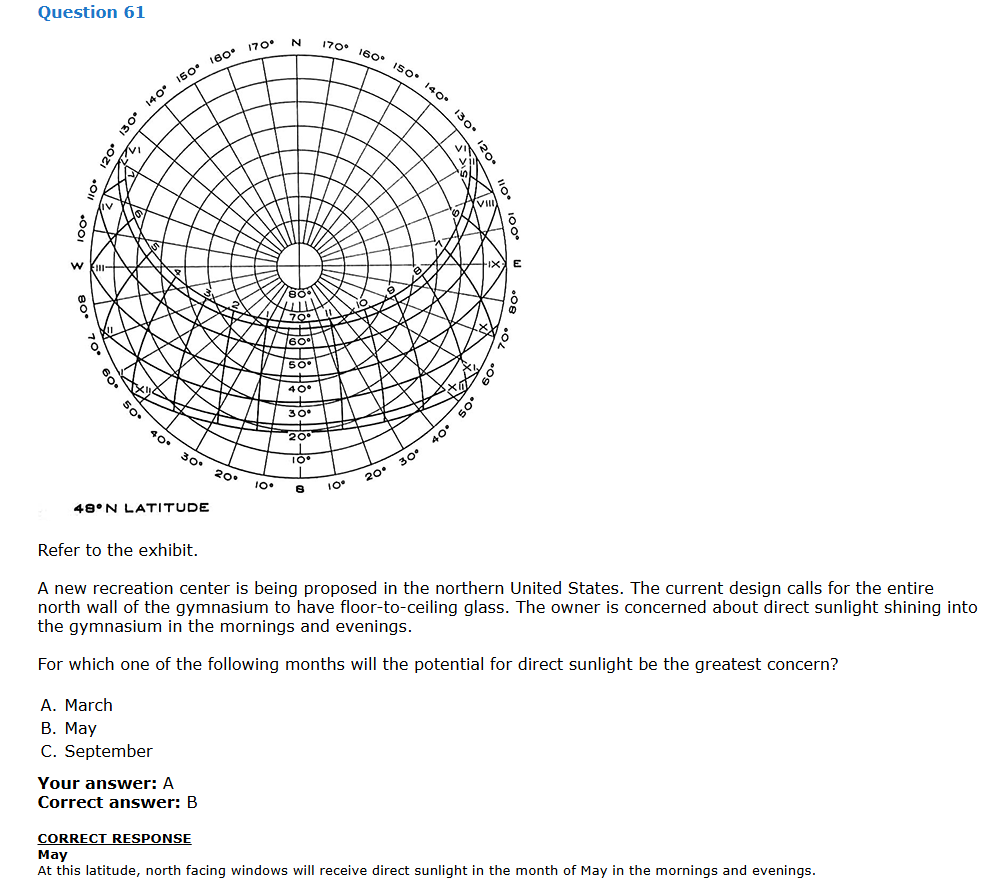
-

The sun is at its lowest in December (winter solstice), and at its highest in June (summer solstice), and between (autumnal/vernal equinoxes) in March/September is when it's at the midpoint between these two extremes. Direct sunlight would be greatest in May compared to the two equinoxes, where they would both be around the same level of exposure.
-
 Architect_inprocess,
So this question is asking you to read a sun-path diagram (though if you know roughly where the sun is in the sky throughout the day for a given general time of year, this question is answerable without the sun path diagram). Sun-Path diagrams are a 2D representation of the 3D sky above a location, showing exactly where the sun was or will be in the sky for the location at any date and time during the year. Each latitude has a slightly different diagram as you slide up toward the north pole or down toward the equator. The attached video shows an axon view of the sun path diagram for the equinoxes and solstices for Minneapolis, which is a good example of a location in the northern United States.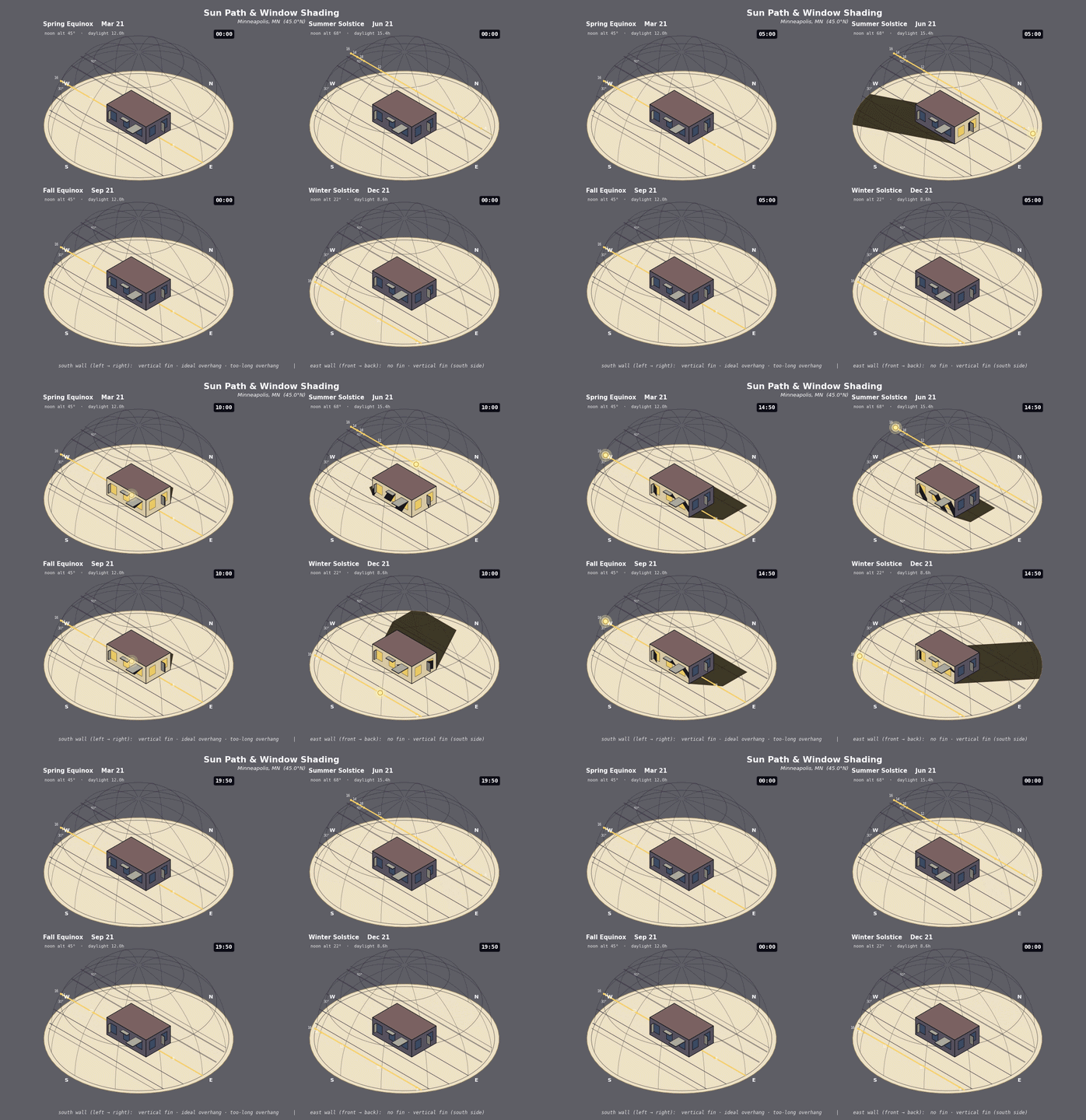
The trick is that the sun is in a different position in the sky - both in altitude (height above the horizon) and azimuth (direction), especially in the morning and evening, at a given time in summer (when we don't want solar heat gain typically) and winter (when we do).In summer, the sun rises above the horizon north of due east, and sets below it north of due west - and is higher in the sky when it is east of south and west of south in midmorning and late afternoon.^This is a good tool for exploring sun path diagrams to get a sense of where the sun is in the sky at different times of the year for different locations.^This is a more sophisticated tool that shows the sun path diagram in 3-dimensions, which may be useful to you to understand what the 2D representation is actually showing. You'll need to change the map setting, but set the same location and date as in the first tool to get an even better sense of what the 2-D sun path diagram is actually representing.
Best,
Ralph, the Amber Book Team -
Charmig,
1. The question asks about greatest concern. That means you're looking for the worst month.
You're drawing a vector that isn't at equivalent times there, but also, that's still a relatively low altitude - to take the example in your image, 6PM in may is only about 15 degrees above the horizon. If you look straight ahead to where the horizon would be in a flat landscape, and hold your fist out in front of you, with the bottom of your fist at the horizon, the top of your fist is about 10 degrees above the horizon. Half a fist again would be 15 - not very high!
I don't know where you're getting 70 and 50 degrees from, unless you're measuring at noon - the question asks you about morning and evening, where the sun is at noon is basically irrelevant. You're looking for where the sun is in the last few hours of the day each day. You're especially looking for when the sun is north of due east and north of due west during the first and last few hours of the day. Of the 3 months given, May is the only one where the sun is north of due east and north of due west at all.
I've drawn the same N-S/E-W lines on both your axonometric view and the 2D diagram, and the same May and Mar/Sept lines in red, and highlighted the same triangular section where the sun is north of due east/west in yellow.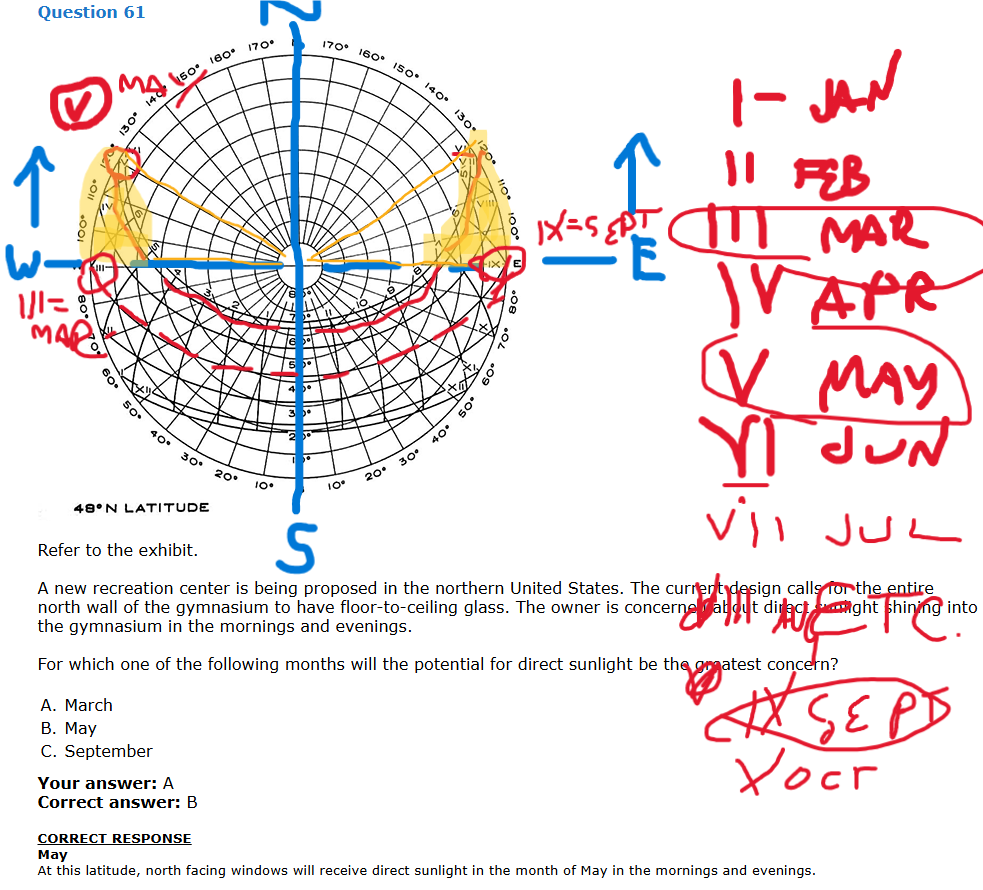
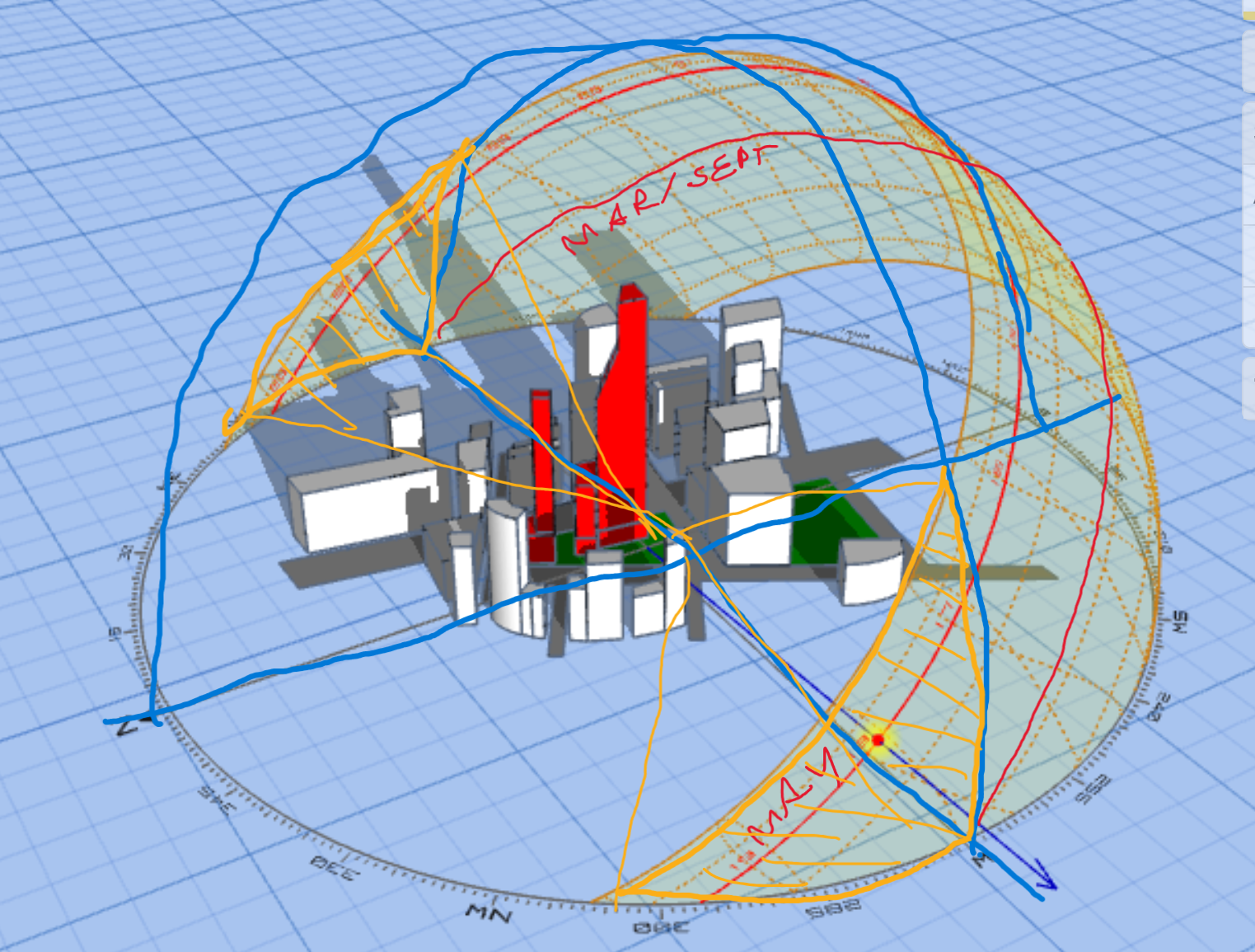
You can see clearly that in May the sun rises and sets such that a north-facing wall will get direct sunlight for a couple of hours in the morning and evening in that month.
Best,
Ralph, the Amber Book Team -

This has already been answered but I just wanted to say, this is a case where you could ignore the chart and just use the text to answer the question. Since the windows are facing north, the answer is the month that's closest to the summer solstice. Therefore the answer is May. June 21st the sun will reach the furthest north in mornings and evenings. Whereas at the equinoxes the sun moves more across the equator.
Please sign in to leave a comment.
Comments
6 comments