Help me better understand this Case Study question (3-Phase Electrical)

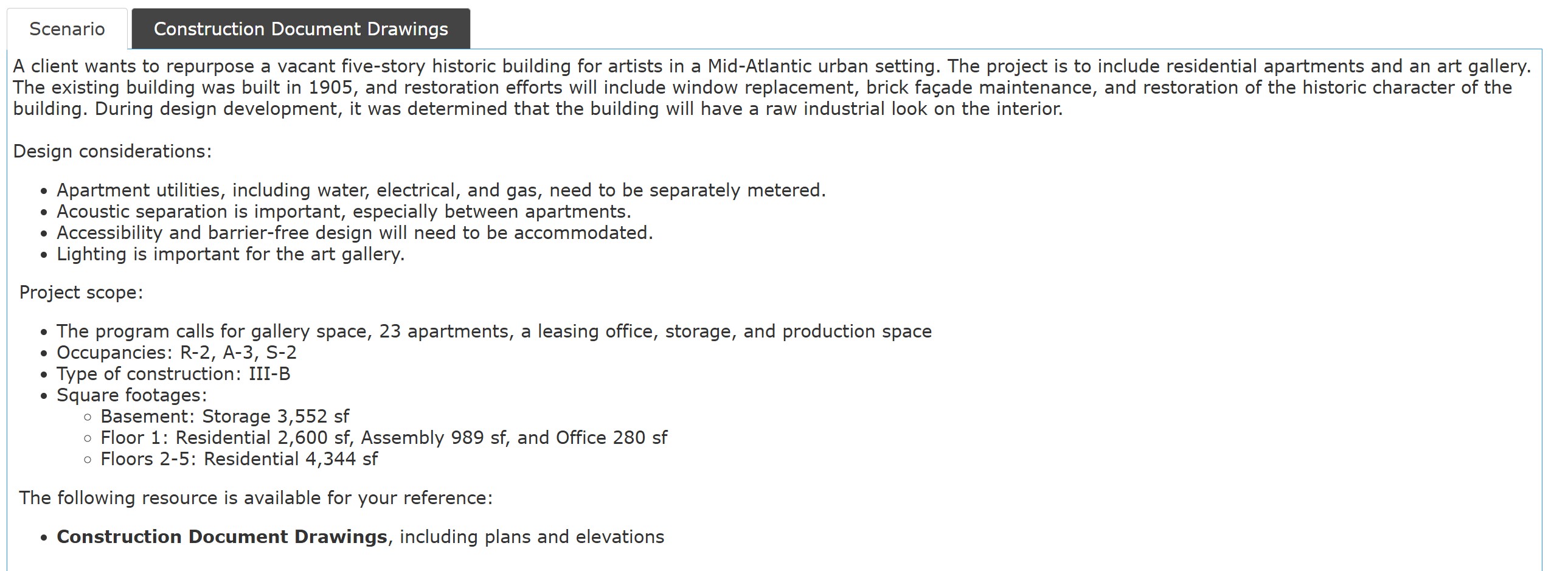
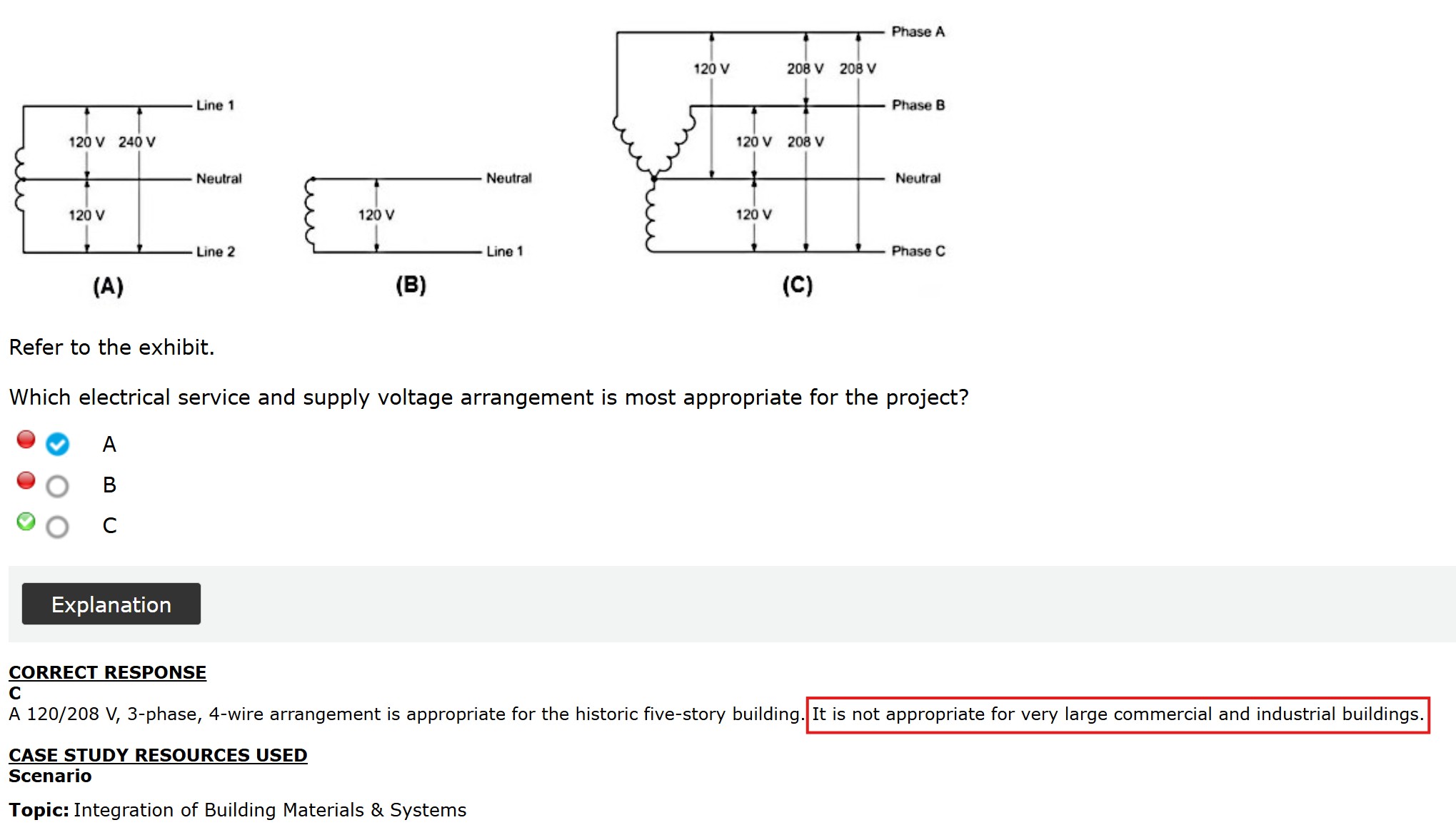
After reading the explanation, I really still cannot understand why 3-phase is the correct answer here. Is it because the building previously might have been 3 phase? But even then, no mention was made that it was for an original industrial application, and the explanation seems conflicting itself.
Input? Just the classic case of needing to know how NCARB wants me to look at this type of question.
-

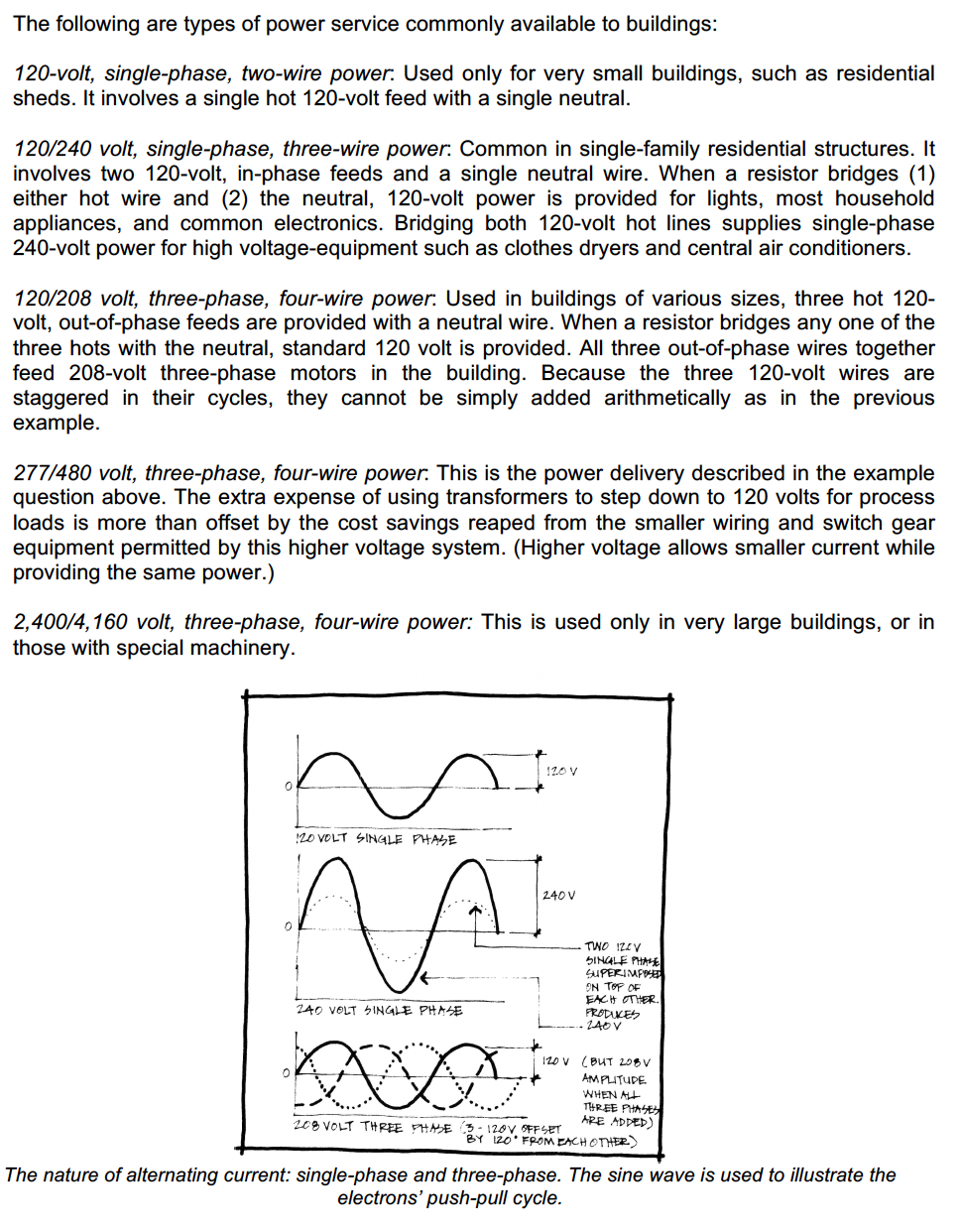
Three phase power will be used for just about any building larger than a single family detached house. The staggered phases mean that for large pieces of equipment, there is never a moment when the electrons stop moving. Why is this important? These larger buildings have bigger motors for elevators, pumps, fans, and compressors. Staggered phases deliver more power to motors, make them run more smoothly, efficiently, and quietly with less need for maintenance and longer life. Were those motors running on single phase power instead, then 60 times per second the power would “stop” as all the electrons changed direction.
Single phase and three phase are the only two flavors available from the power grid.
-Michael Ermann, Amber Book creator
-
Internalize the following:
1. Power (measured in watts) makes the motors spin. More watts means more power to lift a heavy elevator faster and with more weight, so large buildings need more power to operate fans, pumps, elevators, and other equipment. Big buildings need more watts delivered to their machines.
2. Picture a hose filling up a kiddie pool: we can fill it up with a small hose and high water pressure, or with a large hose and lower water pressure. It is the same with electricity: we can bring watts with a small hose (small wire, lower current, fewer amps) and high pressure (high voltage), or with a large hose (large wire, higher current, more amps) and low pressure (low voltage). The downsides: high voltage=more dangerous for electrocution and high current = more dangerous for fire, especially long wires with high current. Wire--like the physical copper or aluminum--is also surprisingly expensive, so there is an incentive to not use thicker wires than necessary.
3. While there are a theoretically infinite number of combinations of voltages ("pressure") and amps ("hose size") to get to a needed power (watts). . . we have to establish a limited number of choices so that our equipment can be manufactured with a known voltage input. We also theoretically have an infinite number of phases and frequencies, but we've decided on either single-phase or three-phase, and everyone gets 60 Hertz, meaning the electrons go back and forth, in alternating current (AC) 60 times per second. In Europe it's 50Hz, so we need an adapter for our plugs when we travel.
With that in mind, we need to deliver power from the grid to our buildings, so we want to pick the option that makes the most sense from a safety, cost, and "can this flavor of power run my air conditioning system?" point-of-view.
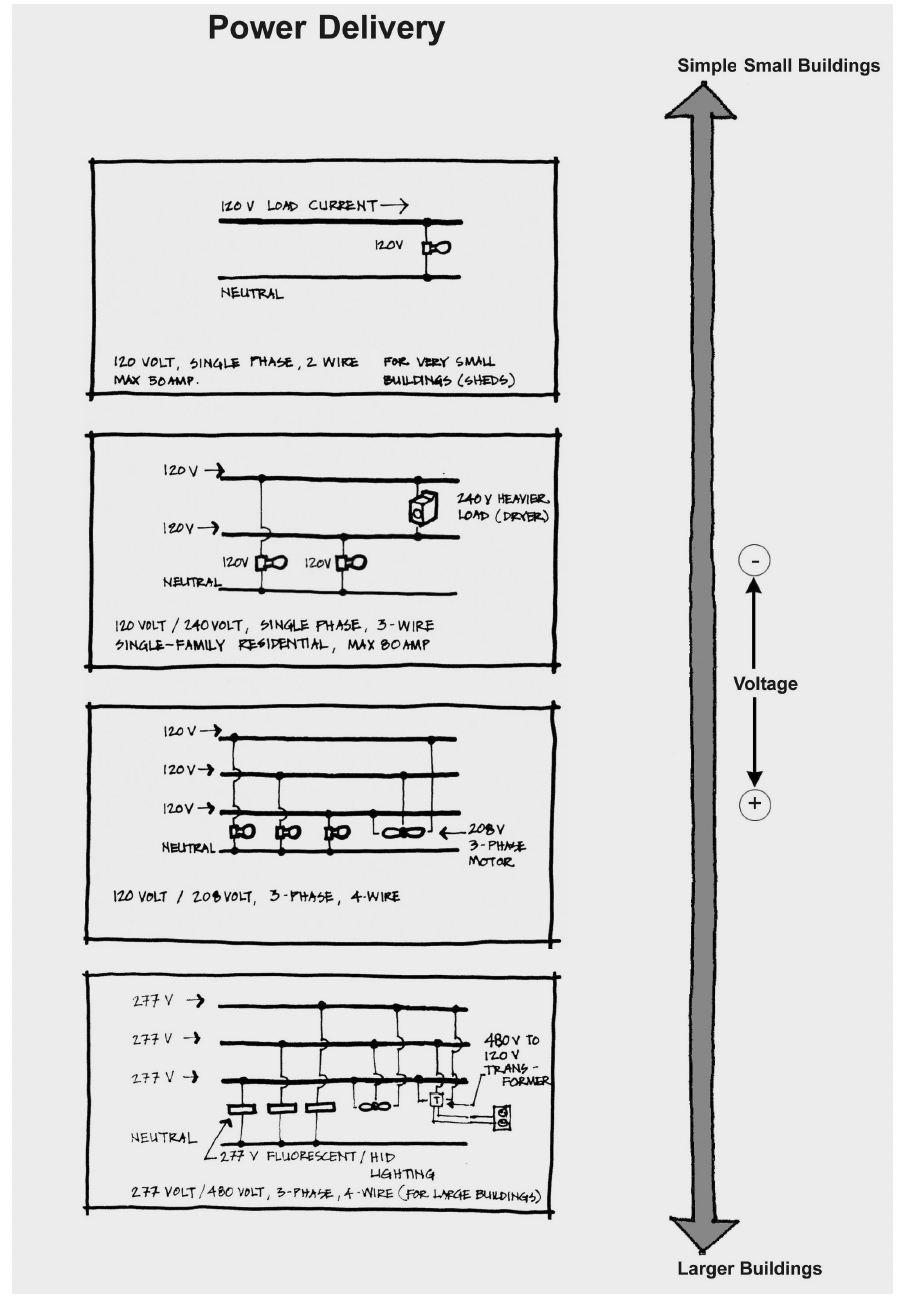
A. 120v/240v, single-phase, three-wire: Used for single-family detached houses. Two 120 hot lines, plus a neutral, enter into the house. The living room and some bedrooms are run at 120 from one of the hot wires, the kitchen and some other bedrooms and bathrooms are run from the other, and the dryer, oven, and air conditioner are run from BOTH hot wires. 120+120, in-phase, = 240 volts where more umph is needed for those appliances.
B. 120v/208v three phase, four wire: used for anything larger than a single family detached house and anything smaller than, let's call it, 40,000sf. . . but it depends more on electrical load than floor area, so that upper cutt off for this flavor could be 30,000 or 50,000sf in practice. Three 120v hot lines plus a neutral wire This flavor of power is for medium-sized elevators, fans, pumps, compressors, etc.. for medium sized buildings. Some classrooms and the cafeteria are fed from one hot 120v wire; other classrooms and the gymnasium are fed off a second, and still other classrooms and the offices are fed off a third. For the reasons I outlined in an earlier post on this thread, all three wires stagger the dance of electrons moving back and forth, so they sway out of phase. This makes for stronger and smoother and more efficient and longer-lived motors. It LOOKS like 208v has less umph than the 240v we saw earlier, but that's a trick. The 240v comes from two lines in phase, so it MAXES out at 240, but is always less than that between cycles. The 208 three-phase is staggered so it MAXES out at only 208, but there are more electons moving in total because it is a steadier flow of power.
C. 277v/480v three-phase, four wire: larger still buildings, over 40,000sf that need more power for their elevators, pumps, and compressors than 208v-three phase. Three hot 277v wires plus a neutral wire enter the buildings from the pole. The lighting runs on 277v (not that dangerous for electrocution because the wiring is at the ceiling level rather than at a receptacle). Higher voltage for lighting = less amps needed = less copper to buy. This is a surprisingly large savings in budget at-scale. How do we plug in our 120v blender in the office break room if the building only has 277v or 480v power? We put micro-transformers to transition the 480v power down to 120v for distribution to the "process loads," which are the "plugs." Get used to calling "plugs" "receptacles" instead. Every industry has its jargon to identify who is inside and who is outside the profession.
Read on to geek out:
*it is, indeed, confusing that the answer explanation includes the line "It is not appropriate for very large commercial and industrial buildings" when the other, incorrect, choices offered in the test item were used for smaller buildings. I picked up on that too when I first read it and thought about addressing it in my first answer, but I thought it was just me.
*This isn't ALL the flavors, but it accounts for probably 99% of the buildings in North America. There is a 120v single phase two-wire flavor (for a shed) and a 2400v/4160v three-phase (for a factory), but best not to worry about those outliers for this exam.
*"I understand how 120+120=240. . . but how do you come up with 120+120+120=208 or 277+277+277=480 in three phase?". . . because the sine waves that describe the voltage over time are staggered, all three voltage peaks fail to arrive at the same moment, so the MAXIMUM voltage at any given moment is the total divided by the square root of three, so 120+120+120=360 and 360 divided by root 3 = 208.
I made a drawing of this, and I'll try to attach it to another separate post below, because if I attach an image, my posts are often flagged and not released by NCARB.
--Michael Ermann, Amber Book creator

Please sign in to leave a comment.
Comments
6 comments