Study Materials

I was the first person in the nation to pass the ARE 5.0, I’ve helped more than 10,000 people study for these exams, and I’m ready to share some insights. The key to passing these tests? No surprise: learning the material. Of course, there are test-taking tricks, both general to test-taking and specific to the ARE that can help at the margins—and I’ll cover those in future posts on this thread—but the quickest, surest path to licensure is in owning the content. For most of you, that will mean a good deal of studying. This will be more fun if you are curious, but for both the curious and uncurious, if you are endeavoring to pass these exams, I encourage you to approach them with a measure of gusto, because owning the content—really really really knowing it—is more fun than trying to memorize a test item that was on your last failed attempt (and unlikely to show up again). And truly understanding the subject matter will both make you more likely to pass and will make you a better architect.—Michael Ermann
-
How Many Case Study Questions?
You will likely have two case studies at the end of each exam division. Each case study will have 6 to 11 questions, so you will have between 10 and 20 case study questions in total, per division, spread almost equally across two case study scenarios.
PcM: approximately 12 (plus or minus two) total case study questions across two case studies
PjM: 14
PA: 14
PPD: 18
PDD: 18
CE: 14
Don’t spend much time reading the case study descriptions; instead use the search bar liberally once you see what the questions are asking. If you are short on time, know that some of the case study questions might not require you to search the case study for an answer. —Michael Ermann The Amber Book
-
Population Pyramid
To own the concept of the population pyramid, which is relevant to the ARE, see this Hans Rosling video. If you want to see more content by this recently-deceased Swedish physician, public health champion, and “person who thinks graphically like an architect,” go here. I can also highly recommend his books. For those of you who are pessimists, a warning that you will come away with a feeling that humanity is doing well. For those who like data, demographics, or the illustration of data in novel graphic formats, you’ll love his stuff. .—Michael Ermann, The Amber Book
-
Responsibility
Owners are responsible for everything site-related: such as geotechnical reporting, permitting, hazardous waste removal, surveying, traffic consultants and anything that is not in contract documents even if the architect has overlooked something. Owners are responsible for programming, which does not include designing anything, but rather establishing adjacencies, budget, etc. Owners are entitled to an on-time, on-budget project.
Architects are responsible for any services required to complete the construction documents. At a minimum, this typically includes a Structural Engineer and a Mechanical/Electrical/Plumbing Engineer but it can also include civil engineers, landscape architects, security consultants, tech consultants, lighting consultants, acoustic consultants, audio/visual consultants, cost estimators, code consultants, sustainability consultants, etc. They are also responsible for code, zoning, staying on-budget and on-time (including answering questions promptly during construction). Architects review the contractor’s invoice and must approve it before the owner has to pay it. Architects work to the “Standard of Care” which is not perfection, but what is standard for other architects at the time. After the owner-contractor agreement has been signed, document every change to the design or program. Charge for changes. If the bids come back to high, the architect must redesign for free to meet budget. The architect owns the drawings and specs. She administers the construction contract negotiation or bid process.
Contractors are responsible for building the project exactly as the drawings and contract documents say it should be built. They are held to high standards (do everything in the CDs exactly as drawn), and are responsible for the means and methods of construction, work site
-
Where is the most effective location for an outdoor noise barrier?
If you have a noise source (truck) and a receiver (person with ears on a balcony), the least effective place for an outdoor noise barrier is halfway between them. The most effective location is as near as possible to the noise source or as near as possible to the receiver. These images will help explain. They are from my book, Architectural Acoustics Illustrated (Wiley 2017). —the book is also 100% of the content in NCARB's seven-part continuum education course by the same name.
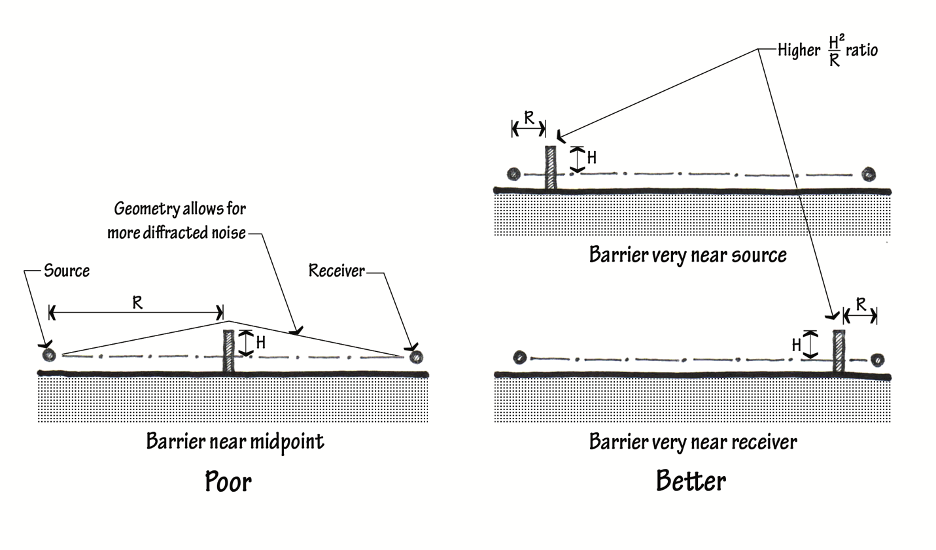
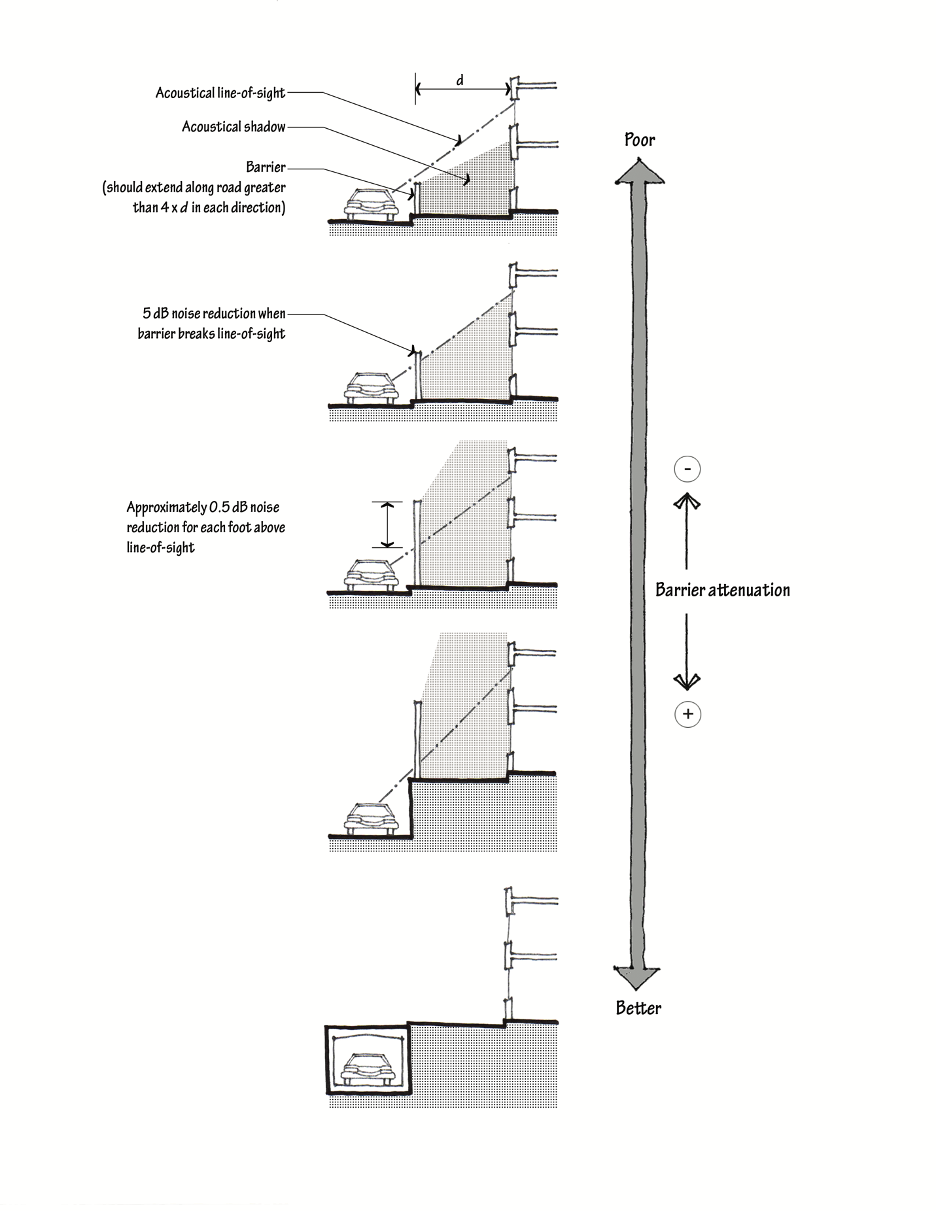
-
What's the difference between Low-e Windows and Tinted Windows?
Low-e windows: These windows perform better than tinted windows, both in summertime solar heat gain (and somewhat for radiant heat loss in the winter), and they do so while maintaining visible transmittance of light. Low-e windows allow the light to pass through, or almost all of it to, but the sun’s heat “sees” the low-e coating that sits between glass panes in an IGU as a mirror. Simply put, the heat is reflected back outside on sunny days, but the light is allowed to pass through.
In the wintertime, the warm objects inside a building radiate heat to the outside through the window, and in theory, a Low-e window will reflect some of that heat back into the room, which is a good thing. Partly inspired by this question, I’ve been running some energy models on a building in a cold climate and, at least according to the models, the Low-e windows seem to provide no meaningful benefit in wintertime. That doesn’t mean that they don’t provide the benefit as the theory affirms, just that my models suggest that the benefit is negligible. There is no question that Low-e windows perform better in summertime and in warm, sunny, climates.
Tinting absorbs some of the sun’s unwanted heat as it passes through the window, but it also absorbs some of the beneficial daylight. Plus, some of that absorbed heat is later reradiated into the room. So by any measure, Low-e is a better choice in new construction or if window replacements are an option. Plus, no one likes the look of a tinted window: that’s one of the reasons why people hate 1980s Houston office parks, but there are so many reasons to hate those. Tinting is less expensive (but again, less effective) in renovations if there is no urge to replace the windows, because a tinting film can be applied to existing windows in situ.
It helps to think about heat transfer in three separate buckets: (1) conduction where the heat moves through a solid (window glass, window frame), measured as U-value; (2) convection, where the heat moves through air (leaks in seams in the perimeter of the window, leaks where the two sashes overlap) measured in cubic feet per minute of air infiltration; and (3) radiation, measured in solar heat gain coefficient (SHGC) which works through electromagnetism, is more like magic, and is less intuitive to visualize. It’s this third radiation bucket where the Low-e has an impact.
Picture the gradient of colors, violet on the right across to red on the left. Color varies by electromagnetic frequency, so the shorter waves are on the violet-blue side and the longer waves are on the red-orange side. There is electromagnetic energy beyond violet on one side and beyond red on the other, but human antennae (eyes) and computers (brain) can only sense and interpret the radiation in that narrow band of frequency between violet and red (visible light). The wavelengths shorter than blue can hurt you. They include UV (black light), X-rays (small risk of cancer), and gamma rays (higher risk of cancer). The blues and UVs also are most responsible for causing plastic breakdown in sunlight. To the far side of red—this is what we are interested in for this discussion—is infrared, which is the heat part of the sunshine. Low-e films act as a mirror to these infrared heat rays, but allow the others in the visible spectrum to move through the window. (Okay, not all the colors go through, but the visual loss on the window is minimal, especially compared to tinting). Tinting absorbs the infrared heat, but also the visible light, then heats up, and re-radiates some of that absorbed heat back outside. . . but some of it re-radiates inside too.
Curious what’s beyond infrared on the electromagnetic spectrum? As the wavelengths become longer, first comes microwaves, then the radio waves that allow your phone to communicate with the cell tower. Radio waves, microwaves, infrared, visible light, ultraviolet, and X-rays are all different flavors (frequencies) of the same thing. The fact that we can only see some of the frequencies is pretty meaningless to the cosmos. – Michael Ermann, Amber Book creator.
-
Why do Concrete Slabs Crack
If you don’t draw concrete control joints close enough to one another, nature will make them for you, only hers will look sloppy and continue to grow larger until the slab spalls. What else causes concrete cracks?
Voids in the soil from insufficiently compacted earth can cause cracks, as can tree roots. Under-slab ground movement from daytime heating (expansion) and nighttime cooling (contraction) can crack concrete. Freeze-thaw cycles too. All slabs crack eventually. . . it’s just a matter of when and how badly.
If the concrete mix is too wet, the slab will crack. Re-entrant corners and penetrations through the slab can cause cracks, as can vehicles or dumpsters parked on a slab. Finally, if the concrete cures too quickly, and is allowed to prematurely dry out, small cracks will form on the surface. That’s why builders often cover curing concrete with plastic sheets. – Michael Ermann, Amber Book creator.
-
How many licensed architects, per capita, does the US have?
Over the last decade, the number of licensed architects has grown by 13%, which is a growth rate of about two times the growth of the American population. That means that there is about one licensed architect for every 3,000 Americans. To see more ARE data, visit the NCARB by the Numbers website here. – Michael Ermann, Amber Book creator.
-
Is compliance with an authority-having-jurisdiction (AHJ) request a basic or supplemental service? It depends . . . compliance with zoning, building, and life safety code certainly falls under basic services, so if the AHJ is in charge of enforcing those rules, there should be no extra charge.
But if the AHJ is the person who certifies LEED, or a person who certifies a semiconductor factory as meeting some level of particulates in the air so that computer chips can be made free of defects, or a person who certifies that a floor for ballet meets some level of bounciness. . . . those are supplemental services and the architect should charge extra for the design changes mandated by the AHJ.
-
Cabinet finishes
An owner, interested in low-cost, low-maintenance, and high-durability hires an architect to design a multifamily building. Which is a better choice for the kitchen cabinet finishes, Acrylic or PVC?
A: PVC
Factories make modular kitchen cabinets by laminating layers of resins and papers under high pressures and temperatures. PVC offers a lower cost, lower maintenance, and higher durability. Then who would specify acrylic? Acrylic offers a glossier finish than PVC, so if glossy is the design goal, acrylic may be a better option.
Curious about the difference in look between the two options? Click <<here>>
-
Go with Your Gut
The case study sections at the end of each exam division have their own particular set of challenges and opportunities. First, on average, these questions require more time to answer, which is why I recommend leaving them until the end. This way, if you run out of time on the exam, you’ve answered the most questions possible because you left the lengthy ones until the finale. Second, you will be surprised how often you will come across something in the case study reference materials that actually answers a question you encountered earlier on the non-case-study section. This happened to me at least once per division. Finally, know that many of the case study questions can be solved without looking at the reference material given. You’ll be tempted to check the reference material anyway because it feels like you should use the supporting documents given to you, but if you already have the answer, don’t do the redundant research needed to confirm your answer choice unless you have lots of time left.
– Michael Ermann
-
Why do architecture firms incorporate as LLCs?
From an ARE point-of-view, the advantage of an LLC over a sole proprietorship, rests in the following scenario: If the building you design burns down, killing people inside, you are much less likely to lose your personal house/personal car/personal retirement savings if your architecture business was first registered as an LLC. Doing so separates your personal finances from your business finances, so one can go broke without affecting the other. The advantage of registering as an LLC instead of filing as a C-corporation (which also protects your personal assets if something bad goes down with the business), is that what you earn from an LLC is taxed only once, but what is earned as a C-corporation is “double-taxed:” the firm makes money and is taxed as a firm, then it pays dividends to its shareholders and they pay personal tax on those dividends. C-corporations are generally used for large companies with many shareholders. . . think Pepsi, Exxon Mobile, and Facebook.– Michael Ermann, Amber Book Creator
-
Surety bonds
Once the bid is submitted, the bidder is obligated to follow through with the contract to build the project, as set forth in the bidding documents, at the offered bid price. They must also furnish any required surety bonds.
Bid bonds and performance bonds are types of surety bonds which work like insurance protecting the owner if the contractor does not follow through with a project to the end. These obligate a third-party insurer to pay the owner to finish the project if the contractor walks away after the contract is signed. Bid bonds will pay the difference between the accepted bid and the next lowest bid if the lowest bid cannot follow through with the work. Performance bonds will pay for the project to be completed if the contractor defaults midway through and stops work. The cost of the bonds should be included in the bid price. As you would imagine, there’s an AIA document to identify and organize the bonds (A312). --Michael Ermann, Amber Book
-

This thread should be removed. It is spam. If someone from NCARB could contact me, I'll explain why it should be removed. Three pages of content by one person... SMH.
Thanks!
Rebekka O'Melia, R.A., NCARB, B. Arch, M. Ed, NOMA, Step UP ARE 5.0 Courses


Please sign in to leave a comment.
Comments
74 comments