Study Materials

I was the first person in the nation to pass the ARE 5.0, I’ve helped more than 10,000 people study for these exams, and I’m ready to share some insights. The key to passing these tests? No surprise: learning the material. Of course, there are test-taking tricks, both general to test-taking and specific to the ARE that can help at the margins—and I’ll cover those in future posts on this thread—but the quickest, surest path to licensure is in owning the content. For most of you, that will mean a good deal of studying. This will be more fun if you are curious, but for both the curious and uncurious, if you are endeavoring to pass these exams, I encourage you to approach them with a measure of gusto, because owning the content—really really really knowing it—is more fun than trying to memorize a test item that was on your last failed attempt (and unlikely to show up again). And truly understanding the subject matter will both make you more likely to pass and will make you a better architect.—Michael Ermann
-
How Many Hours Does Someone Need to Study to Pass This ARE Division?
There are so many problems with this reasonable-sounding question. It reveals a failure to think probabilistically (more on that in a later post), and it fails to account for individual prior knowledge of the material, which varies across test-takers. But mostly, it promotes over-studying. Let’s say that you have 200 hours available to study in a three-month period. Is it better to study one division and get to a state where there is a 90% likelihood of passing that one division. . . or is it better to spend 100 hours on each of two divisions and get to an 80% likelihood of passing each of those two divisions? It’s the second scenario that’s better for you. In a given window of time, better to study for two divisions and achieve 80% likelihood of passing each of those, than to study one division and get to 90% likelihood of passing only one division. This is because if you chose to study for one test, you likely could have passed two instead, and even if you failed one of the two, you still broke even in that case because you passed one test, like in the first scenario where you only studied for one test. But with the two-division option, you already have 100 hours of studying under your belt for the retake of the failed division. For too many people their goal is to pass the next division, and it is important to have microgoals for the long process of licensure so you can celebrate the interim victories. But the overarching goal should be to pass all the divisions in the least amount of time.
-

Well, at least they have the gut to stick to it and pass all exams. 😊
In a sense, an architect’s license is like a driver’s license. ARE is NOT an exam to test some mysterious, advanced architectural knowledge that no one else know about. It is testing some COMMON and BASIC architectural knowledge that an architect uses daily to fulfill an architect’s duty. NCARB is testing your knowledge that affects life and safety that every architect should know, and NOT testing your ability to do fancy designs.
Gang Chen, Author, Architect, LEED AP BD+C (GreenExamEducation.com)
-
When Over-studying is Okay
You want to follow a path that gets you to the highest likelihood of passing in the least amount of time studying, and your study materials should support that goal. If you’ve read my previous posts, you know I maintain a steadfast position against over-studying. You think you might be ready to take an exam division? . . . Schedule it! Better yet, take all your remaining divisions now and study only for the ones you don’t pass. There are times, however, where extra study is warranted. If you honestly think that you know much less about a topic in our field than others do it’s okay to study far beyond what I recommended in my prior posts. I’m not talking about “imposter syndrome,” an unfounded doubt in one’s own accomplishments and a fear of being exposed as a fraud, but extra studying is sanctioned if you’ve fallen behind and have no idea what your engineers are talking about when they say “air-handling unit,” or you can’t intuit what “sound transmission” means (it means what you think). If you have one more exam division to pass and your running clock allows you only one last re-take of that division, then, by all means, study hard. If you fear being fired if you don’t pass (I had one person tell me this), then study hard! And importantly, if you are the one-in-six emerging professionals who I meet that enjoy studying—if you geek-out on learning this stuff like I do—then study vigorously and unapologetically. You’ll be better at your job if you do.—Michael Ermann, Amber Book creator
-
Masonry!
Study stone anchoring, strength, and patterning, as they relate to the ARE, here.
-
What Study Materials Do You Recommend?
Mechanical and Electrical Equipment for Buildings (MEEB) (especially the images), Fundamentals of Building Construction, Building Construction by Mehta, The Architect’s Studio Companion, and The Architect’s Handbook of Professional Practice are five books that are most widely cited as study material, but those five books are 5,000 pages long, and only three of them are good reads (the other two are better as reference books). For most people, I believe that the Amber Book online video course alone provides the highest likelihood of passing in the least amount of time studying (See examples of the course here). I know this because more than a thousand people keep writing us, unsolicited, and telling us so. If you’ve finished the Amber Book course and still want to study more, study the images—the diagrams, photographs, graphs, and drawings—in MEEB, chapters 5, 9, 10, and the last three chapters in the Architect’s Handbook of Professional Practice, and the AIA B101, A101, and C401 agreements. Many others study Sun, Wind, & Light (I prefer the second edition to the third edition), and Heating, Cooling, Lighting. Each is a great read, but will have a more modest yield: fewer extra exam questions correct, per hour of studying.
-
You Need Test Tricks but You Need Content Ownership More
Today I saw a thread about someone worried about varied sources suggesting different best practices for rounding numbers in ARE calculations. Don’t worry about those kinds of things (in the case of rounding, the exam will accept a range of values to account for variations in individuals’ rounding routines. . . . but in general, you won’t get a test item wrong because of formatting issues). Be wary of people and products that excessively focus on testing tricks. Actually owning the content, really knowing it, is both the surest and the fastest path to licensure. Don’t get caught up in interpreting NCARB’s intentions, or standardized test strategies. You don’t fear easy tests, even when they are high-stakes easy tests, so learn enough to make the test easy.—Michael Ermann, The Amber Book
-
Building Foundations
Study soil types and foundation failures, as they relate to the ARE, here.
-
Fake It Till You Make It
Have swagger (or fake it) on test day because even feigned confidence is better than abject terror. If you're not testing at home, dress in layers so if you overheat you can peel and if it is over air-conditioned you can layer-up. Remind yourself that when you encounter a question you just don’t know, guess, flag it so you know to go back to it, and move on without remorse. Often material covered in a later question or material included as part of a case study will answer the test item you flagged. Plus, obsessing over a question you don’t know the answer to is not likely to help you come to the solution, and it risks slowing you down to the point where questions might be left unanswered as time runs out. Start going to bed early three nights before test day, because you may not sleep well the night before the test, no matter what you do. Exercise and eat well while you are studying; it’s worth the time away from your study materials to maintain a clear head. Stay positive and remind yourself that anxiety will do nothing to serve you. Go easy on yourself if you fail (failing is a feature, not a bug. . . you’ll schedule a retake) and if you pass, take some time to celebrate with the loved-ones you ignored the previous months while you studied.
-
The Final Four of Building SystemsGet your bracket fix while studying. . . Print out and fill out this final four bracket for your current design project at work in the same way you would for March Madness. It’ll be fun and useful. and when you're done, you can review the meaning of the items that stumped you here.
-
An architect created an incomplete set of specifications. The architect maintains that the failure was within the Standard of Care, but the client maintains that this oversight goes beyond that threshold. How is the dispute resolved?
Once the machinery of construction dispute resolution gets fired up, the parties have crossed a threshold requiring time, money, and distraction from their other everyday work tasks. Often both sides’ representatives come to a compromise on their own before the dispute moves to a mediator, whose decision is non-binding. If one side, disputing the mediator’s proposed solution, wishes, the dispute graduates to binding resolution. There are two flavors available for binding resolution, and the option used for this project would have been decided more than a year ago, long before a dispute arose, when the Owner-Architect agreement was first signed.
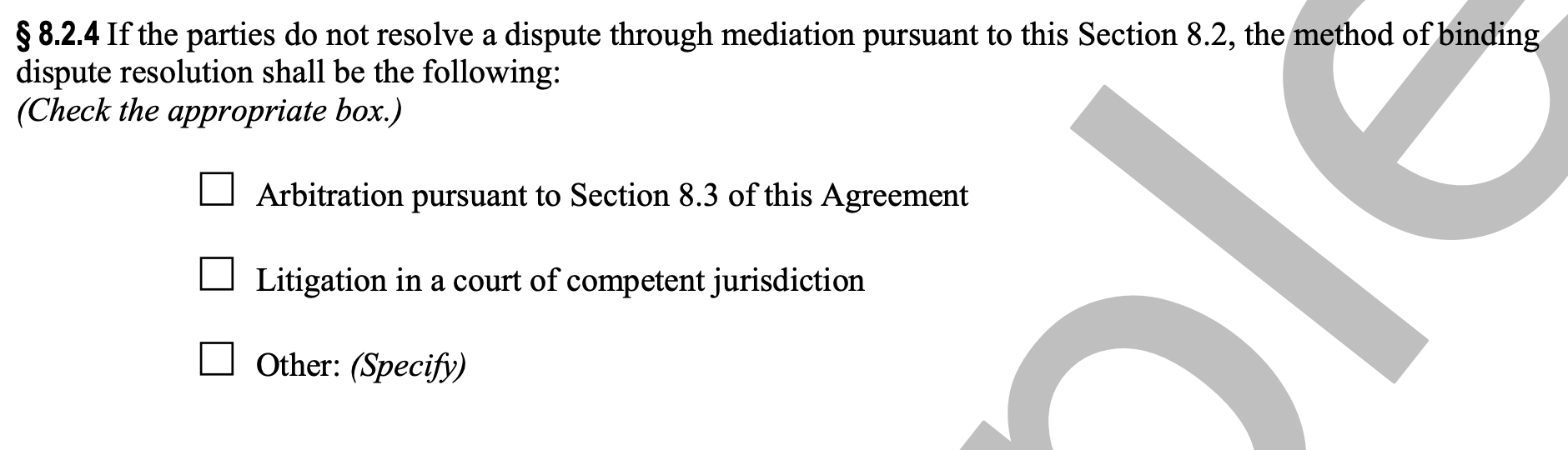
There’s a checkbox section in the Owner-Architect agreement for the parties to choose: if the non-binding mediator can’t come to a decision that everyone likes, the dispute moves to either (1) a binding arbitrator (a third-party professional, with extensive knowledge of construction law, who purports to be impartial and whose decision is agreed to as final ahead of time by the parties) or (2) a court in the location of the project (where a jury—with limited knowledge of construction law but a collective sense of basic fairness—will hear the case).
In the agreement, each side agrees to split the mediator’s fee equally. If neither the arbitration box nor the litigation-in-court box is checked on the agreement, the dispute automatically moves to binding litigation in court after a mediation decision that one side does not accept.
-
Keep Quiet!
So why do people over-study? Why do they study for one test until they get to a 90% likelihood of passing instead of studying for two tests in the same time window and getting each of those to an 80% likelihood of passing? It is because they are not visualizing the difference as a slight decrease in passing likelihood from 90% to 80%. Instead, they are visualizing a doubling of the failing rate from 10% to 20%, and they’re doing so because of pride. Oversharing begets over-studying. When you announce to your boss, your friends, your social media followers, your coworkers, your old college roommates, and the person with whom you share a bed that you are going to be sitting for an ARE exam division next week, you are inviting them to ask you how did it go? did you pass? You may be recasting a fail report, which is a normal part of the process (see an earlier post), into a personal and often profound embarrassment. If you take nothing away from these posts, take this: stop telling people you are taking the divisions. Tell no one. Share instead with your friends once you’ve passed a division. You’ll earn their respect and get through the examination process in less time. I—Michael Ermann, Amber Book creator
-
Over 35 and Studying? You’re Not Alone.
I’m not surprised when I hear from someone having trouble balancing work, home-life, and studying, but I’m surprised that those who reach out to me give me the impression that they think that they’re alone in this dilemma. I’m never sure how to strike the balance in my response: I genuinely hurt for them and want to tell them they are not alone, but sometimes I think that response comes across as “Your problems, the ones that are crushing you, are not that special and everyone else is dealing with them too.” So I’ve taken to phoning folks. Empathy doesn’t transfer well by email.
This seems to be more prevalent in the over-40 crowd, who have the stresses of raising children and, maybe, caring for an aging parent. If you graduated college in the last five years and are considering sitting for these exams, do it! Now! You’ll be busier later.
If you’ve waited, that’s great too. I think most people I come in contact with wait a bit longer than they wanted to before sitting down with the exams, but the average age of exam-takers is dropping. The median age for licensure is about 35, which means if you are over 35 and not yet licensed, about half the people who will eventually be licensed are in the boat with you. I was 43 when I became licensed.
It’s a funny mixture of, “I can’t study because I’m so busy at work,” which feels kind of like it’s part of the public discussion . . . and, “I’m buried by my family responsibilities,” which not only is under-discussed in the public square, it’s actively concealed. Online everyone looks so busy, yet so unburdened.—Michael Ermann, The Amber Book
-
ARE 4.0 Study Materials Okay to Use?
Sure, you can use ARE 4.0 study materials to prepare for the ARE 5.0 exam. When they switched over from 4.0 to 5.0, NCARB kept the 11,000 test items from the old version of the exam. They reshuffled them, spread them out on the table, and made six new piles out of them corresponding to the six ARE 5.0 exam divisions, but they are the same questions. . . .only now there are more questions on the business of architecture and fewer questions on structures.. . . and of course lots of new questions on lots of topics that have been added over the last four years. –Michael Ermann, Amber Book creator
-
The Type of Question Does Matter
While worrying about the question type (drag-and drop, case study, etc.) isn’t helpful when studying, there are two tips to share regarding question types once you are taking the exam. The first tip involves drag-and-drop and rotation: right-clicking on the mouse will allow you to rotate the object you are dragging, so if, for instance, you are dragging grab-bars and placing them into shower stalls, a mouse right-click after you’ve grabbed the object (shower grab-bar in this case) will rotate that shower grab-bar 90 degrees so it can be dropped in its proper orientation. The second tip involves the case study questions: use the search feature in the case study questions! This is a timed test so you shouldn’t be browsing this case study code material to look for the occupant load factor of a commodities exchange. Search for the part of the phrase that is least likely to show up everywhere (in this case, “commodities” is a better search word than “occupant”) and it is likely you’ll be taken right to the place you need to be in the document. The search bar seems obvious to most of us, especially the youngest among you reading this, but you’d be surprised how many people tell me that they didn’t know about it beforehand and didn’t notice it when sitting for the exam.—Michael Ermann, The Amber Book
-
Air Conditioning for People Who Don’t Know Much About Air Conditioning Part 1
Own the compression-refrigeration cycle as it relates to the ARE, here. This one comes in three parts. This is Part One
https://www.youtube.com/watch?v=2wZb6HgIDE0&list=PLRqQUel8W0R6t0eDPnaCi1sPt4ao9CXQA&index=17
-
Leakage
Remember the last time you went to the airport for a short trip and parked in the garage? Long-term parking, north garage, second floor, between columns G8 and G9. You can remember that. It’s important, easy to remember, and you’ll be back in less than three days.
But you forgot anyway!
We tend to assume that our brains remember like computers, able to retrieve a file when necessary, but neurobiologists know that we have context-sensitive memories instead. We remember because we associate one smell that reminds of another experience that reminds us of an old friend which reminds us that we need to call tonight and see if we can switch to a less-expensive phone plan. It’s remarkable how well we remember knowledge that is tied to a story; it’s remarkable how quickly we forget knowledge that isn’t tied to a story; and it’s remarkable that we forget how quickly we forget knowledge that isn’t tied to a story.
What can you do about it? First, when possible seek out study materials that (sometimes) share knowledge in the form of a story—a narrative about a building foundation that exceeded the building’s total construction budget, a contract that went bad because of an implied warrantee to meet LEED certification, or a tragic death from electrocution because of a circuit short. Second, you can study intensively for a shorter time and take all of your exams together and as soon as possible after studying so that you don’t lose too much knowledge in leakage while you are waiting to find time to study more. Then, if you fail a division, reschedule it for the most immediate date available.—Michael Ermann, The Amber Book
-
How Many Do I Need to Get Right On this Practice Exam?
If you’ve been reading my previous posts, you won’t be surprised by my allergic reaction to this question. Each division has its own cut score and they range so that 57% correct may be a pass in one division and 67% may be a fail in another. Each exam is assembled carefully by NCARB with both knowledge of the questions’ metrics (the proportion of past test-takers who successfully answered each question, each question’s point binomial distribution, etc.) and on the correct balance of difficult and easy questions to meet an established target. No test prep provider has enough such data for you to get much meaning out of a practice test score. I fully understand the urge to measure yourself to mark improvement and gauge readiness, but don’t take any joy or suffer any shame in a given practice test score, because that number is probably meaningless.
Nor is it important that a practice test have a similar format to the real test. Aside from running out of time (a common problem, but one that might be addressed by the new, shorter exam format coming out next month), people don’t get questions on these exams wrong because they don’t understand the formatting of the question; they get questions incorrect because they don’t know the answer! If you’ve already taken one of these divisions, think about your own experience: was there a question that you got wrong, but would have gotten right if you were only more familiar with the test format?
Instead use the practice problems to introduce you to topics that you might not have thought to study otherwise, and to get a general feel as to whether you own the concepts and are ready to schedule the exam. (If you think you might be ready, you are!) I do love practice tests, just don’t try to squeeze meaning out of your score on them. Starting your studying with a practice test is great for creating doubt in the learner, and doubt is an important part of making learning sticky. Don’t fear doubt.
-

As a person who runs a practice exam website - I fully echo this statement:
use the practice problems to introduce you to topics that you might not have thought to study otherwise, and to get a general feel as to whether you own the concepts and are ready to schedule the exam. (If you think you might be ready, you are!) I do love practice tests, just don’t try to squeeze meaning out of your score on them.
Mark, Archizam
-
Multiple-Choice Tests
In my experience, most of the test items on the ARE are in multiple-choice format, and multiple-choice tests are irresistibly attracted to comparing names of different categories of things. It’s catnip for test-makers: comparing the relative merits of the available plumbing valves, brick weathering flavors, electrical building service families, building acoustics metrics, and soil types.
-
What is an initial decision maker (IDM)?
Remember that the owner hates to negotiate with the contractor when there’s a giant foundation hole in the ground that only he, the contractor, can fill with a building. Remember that no one really knows what a project will cost the contractor to build until it’s completed, so all bidding is, at best, an educated guess. Remember that there’s millions of dollars to be made and lost in this game. Remember that buildings are complex, and the drawings aren’t responsible for spelling out everything, but rather only the design intent. Remember that that everyone hates delays to the schedule because they’re costly to everyone. And remember that the legal machinery associated with claims involves expensive lawyers. So, this world is not for the conflict averse: they’ll be disputes, most commonly between the owner and contractor. Don’t like conflict? Get past it and fake it till you make it.
The AIA 201 General Conditions of Construction—the rules of the game for the owner, architect, contractor, architect’s consultants, and owner’s subcontractors—provides for an Initial Decision Maker (IDM) to make non-binding calls to resolve small disputes as they arise throughout construction. The architect serves as the default IDM unless a different party is specified as the IDM in the AIA A101 Owner-Contractor Agreement.
Historically, the architect was always the IDM, but that role must be filled by someone impartial, and contractors became understandably suspicious that the architect-referee would be unlikely to judge that (1) his drawings were insufficient, or (2) his boss, the owner, needed to pay the contractor more money for that insufficiency. Beginning in 2007, the owner and contractor could name someone else in the contract as the Initial Decision Maker, but if no one else is specified on the AIA A 101 Owner-Contractor Agreement, the IDM role automatically defaults to the architect.
The IDM can approve a claim, reject a claim, propose a compromise, or remove himself from the claim altogether. All claims headed for mediation must first be run past the IDM in the hopes that legal fees may be averted by a non-binding decision made quickly and for free by someone already intimately familiar with the project.
*If the claim goes to mediation, a national organization of mediators and arbitrators selects the mediator to hear the case based on its own internal rules.
-
How badly did you fail?
If you just barely failed, schedule the exam again for the soonest possible date (60 days after the last sitting for that same division). Do it right away when you receive your NCARB fail report so you can avoid wallowing, can be solutions-oriented, and most of all, so you don’t lose the content that you already studied by waiting too long to re-test. If you failed miserably, you might need to study some more. If you are not sure if what you did is considered “failing miserably” or “failing just-barely” assume it is the latter. —Michael Ermann, Amber Book creator
-
Calculating minimum stair width
You calculate the stair width--for the whole stair system--based upon the floor with the highest occupancy load. That floor's width controls all the way up and down the exit stairs, so you don't have to add cumulatively. For stairs serving one floor and fewer than 50 occupants, the minimum width is 36". For stairs serving multiple floors, the no-matter-what minimum width (always measured between handrails) is 44". To calculate the minimum width for your building, you'll take the floor with the highest occupancy and multiply that occupancy by 0.3 (multiply by 0.2 if sprinklered and not a fireworks factory or prison, but I'm going to use 0.3 going forward for simplicity). After you multiply the highest-occupancy floor's number of people by 0.3, that will give you a minimum TOTAL width, inclusive of all your exit stairs. You'll split that total up between the total number of exits required for your building:
Occupant Load per Story: 1-500: 2 stairs; 501-1000: 3 stairs; more than 1,000: 4 stairs
So if you have 100 people per story and four stories, you will need two exits, minimum. You'll multiply 100*0.3 to get a minimum TOTAL stair width of 30", divided across two exits, which returns you 15" per stair. But, there is a minimum stair width of 44" so each stair will be a minimum of 44"
If instead, you have 600 people on your third story and 100 per floor on the other levels, you'll take 600 * 0.3, which returns you 180 inches and minimum number of three exits, so 60" per exit stair and three exit stairwells.
Only stair widths within 30" of a railing "count" as egress, so were the width of the example above more than 60" wide, we'd need an intermediate rail in the middle of the stairs (or more likely, add a fourth stair). An intermediate stair rail looks something like this. https://i.pinimg.com/originals/09/82/64/098264fef1ba1a445aafa7f39cc395d4.gif
There are exceptions for refrigeration rooms and daycares and all kinds of different rules such that you should never use my generalizations in lieu of your own code search when designing your buildings. This is just provided as a general rule-of-thumb, useful for studying, but not verified for your particular building and never appropriate to replace your own code search. .—Michael Ermann
-
Water Pressure
If you’ve been studying a while, you likely have run into the concept that lifting the water in an above-the-building storage tank 2.3 feet higher creates an extra 1psi of pressure in a downfeed system. But know that the inverse is also true: 1 psi of pressure raises water in your supply pipe 2.3 feet higher.
This second, flipped, concept trips many people up. While every 2.3 feet higher you store the water in a down-feed system creates one extra psi at the fixture (this part is intuitive). . . it is also true that every extra psi in an up-feed system (like from an underground municipal system) is able to push the column of water 2.3 extra feet higher into the building (less intuitive). So if your plumbing fixture is 120 feet in the air and your plumbing fixture requires 15psi to work properly, you will need 120ft/2.3ft per psi=52.2 psi to push the water to the height of the fixture. But the fixture itself requires an additional 15 psi to work properly (just pushing the water up to that height might not allow the tank to fill properly; we need extra pressure for that). So the line into the building requires the following pressure: 52.2 (to lift the water 120 feet) plus 15 (to operate the fixture) equals 67.2psi.–Michael Ermann, Amber Book creator
-
I’m Playing Lottery Numbers 1, 2, 3, 4, 5, 6
Last night’s lottery ticket numbers were 11-12-19-30-53-04. Recognize that the odds of that series of numbers coming up are equal to the odds that 01-02-03-04-05-06 would be drawn instead. But, you protest, you’ve never seen a lottery where the winning numbers were 01-02-03-04-05-06, to which I counter that you’ve also never seen a lottery, before now, where the winning numbers were 11-12-19-30-53-04.
Likewise, because you saw a picky, overly-specific question on an ARE exam, does not mean that memorizing picky, overly-specific details will help you on your next test, precisely because it is so unlikely that you will memorize the exact picky, overly-specific topic that will be included in the next test. The Architect’s Handbook of Professional Practice, MEEB, and Fundamentals of Building Construction are 4,000 pages in total! Unless you have information that something should be memorized (and, to be clear, some things should be memorized for these exams. . . . I’m looking at you, concrete types) there is no reason to just start memorizing material scattershot in the expectation that you will be tested on that topic. It’d be like playing 01-02-03-04-05-06 on the lottery. Sure your numbers could win, but they won’t.
-
Procrastination works, but only if you start early
If you have a difficult or unique problem, or if you have one that requires a creative solution, start addressing the challenge as soon as possible, but no need to finish it early. Instead, let your brain marinate on the matter for several days and see if you don’t wake up one morning with a solution. Since reading about this start-early-end-late technique, I practice it regularly to great effect. This may be more relevant to your practice than to your ARE study schedule.
-
Do We Really All Learn Differently?
Despite what you’ve heard, most of us learn the same way. Research in the area of learning science—how humans come to understand and especially how humans remember things—started much later than other areas of cognitive science. And once people started looking into how we learn and remember, their findings were particularly slow to disseminate to the broader public. Here’s what learning science tells us as it relates to memory. . .
Narrative is better: Our memories don’t work like computers with files that open upon command. Instead, we have a context-sensitive memory where something we hear, smell, feel, or see reminds us of something else. Our evolutionary ancestors saw that the last four people who explored the left fork in the path didn’t return alive, so they created a story about a monster that lives in a village at the end of that left-fork path. Future hunters knew from the story not to choose left.
So when studying, make a story out of the content to help you retain it. For instance, architects who charged based on a percentage of construction costs and their clients were suing one another over whether the value of volunteer labor should count toward construction costs. The clients thought it shouldn’t, but the architects recognized that failing to account for volunteer labor and donated materials would limit the architect’s compensation. The contracts, therefore, clarified that the value of donated labor and materials should be included in the cost of the work. .—Michael Ermann, The Amber Book
-
One Point
Every question is worth one point. You need a certain number of points to pass the exam, regardless of which sections those points came from, so there really is no “failing a section,” of an exam division. Getting an extra exam question correct in a level four “failed” section will get you no more, and no less, closer to passing than getting an extra question correct in a level one “passed,” section instead. I could not be more certain of this. —Michael Ermann The Amber Book
-
This is a great point, but not everyone gets it. In more than one occasions, I have met people who want to argue about this.
Gang Chen, Author, AIA, LEED AP BD+C (GreenExamEducation.com)
-
Add R-values Inside One Assembly, but Never Between Different Assemblies
I got this question from an enrollee: why do we need to do a separate heat loss calculation for the window and opaque materials, instead of adding them together?
It depends on how you define "together." If you just add the R-values of the window and the wall, then a building with 90% of the walls covered with windows will have the same R-value as an otherwise identical building with only one small window, and that can't be right, right? Likewise, I can't put only one square foot of great insulation on my building and somehow "add" it to the R-value of the rest of the uninsulated building to derive an inflated “total” R-value. You will instead need to add the R-values of materials within a SINGLE assembly, but you cannot add the R-values of different assemblies to come up with a whole-building number.
You CAN calculate a whole-building AVERAGE U-value and then use that to calculate heat loss or compare design options. But again, you cannot simply average different U-values without accounting for what portion of the building skin is attributable to that specific assembly and its corresponding U-value. Imagine again that we have two buildings next to one another, one with almost all glass and one with only one small window. If we used the same opaque assembly and the same window glass for both buildings, then both buildings would have the same average U-value. . . but that makes no sense. To derive a whole building WEIGHTED average, we instead need to multiply each assembly's U-value by the corresponding percentage of the skin area of that assembly: For example, U-value of the windows times the 15% of the skin that covered by the windows, plus the U-value of the opaque wall times the 40% of the skin area that the opaque wall encloses, plus U-value of the roof times the 45% of the skin area that the opaque roof encloses. That way the building with lots of glass will have an area-weighted U-value much higher than the building with only one small window.
If this is all too complicated for you, I TOTALLY understand. Easier to remember this. . .
- Add R-values of materials WITHIN Assembly X to derive the total R-value of Assembly X.
- Take the inverse of that number to calculate the U-value Use that number to multiply by the skin area of assembly X and delta-T. That gives you the total heat loss through assembly X.
- Do the same for assembly Y. Once you get a heat loss value for Assembly Y, you can add the heat loss values, in BTU/hr of Assemblies X and Y and Z and so on. If you have two types of windows, three types of walls and one type of roof assembly in your building, you will have 2+3+1=6 different heat loss values to add together to evaluate the total building heat loss.
- Never add R-values of different assemblies. If you have an itch to average R-values so you can come up with a whole building value, scratch it by area-weighting the average U-value to account for how much of the building is covered by each assembly.—Michael Ermann The Amber Book

Please sign in to leave a comment.
Comments
74 comments