NCARB test - Why lot B instead of D

Lot D doesn't interfere with the drainage path and is right along the street. I don't understand why NCARB choosing lot B as the answer. 
-

Looking at the options and the program to meet: A is too far from the street to have the requested visibility, and C will interfere with the existing landscaping. D will interfere with site drainage, as it's interfering with the runoff flow (see below). B makes the most sense as it does not disrupt the site in a way that will affect the natural runoff pattern and is visible from the street.

-
I appreciate you marking it up, but I don't think the runoff of this site works like this. I thing it is more toward the middle rather than the entire site. I reread the question and I think I see what I missed. the question says the inventory with most visibility NOT sales and service building. They are two different buildings, so the inventory is B and sales and service is D.
-
The sales and service building will be the permanent structure that is being located on the plan. Inventory parking will fall wherever on the site that can meet the requirements, but that's solving for another problem. The footprint of option D as drawn disrupts the drainage on site as it exists now; water running from the top of the site to the detention pond would not flow past the corners of the footprint evenly, diverting and disrupting the current drainage pattern of the site.
-

The main difference between B and D is in the question: Owner wants to locate vehicle inventory with maximum visibility from the street. Option D blocks the vehicle inventory view from the street, while option B does not. B and D are approximately equal in terms of the drainage and landscaping criteria.
A and C don't meet the criteria for maintaining drainage and/or landscaping.
Also -- these are locations of structures on a single lot. Not 4 individual lots.
-

Hi, Parisanvd!
I agree with you! When I read and then re-read the questions, they are talking about two DIFFERENT buildings. Lot D would be for showing off car inventory, B for the sales and marketing. What a tricky questions. GD! You really need to read these questions carefully. I also agree with you that although abruno’s comment was nice to post, it doesn’t really make sense because the exact same logic could be applied to lot B. Anyway, I’m studying for PPD now. Thanks for posting!
-
jfairbanks the question mentions one sales and service building and one inventory lot for parking. It's one built structure that needs to be located and considered for this scenario. Considering where the inventory lot has to be located muddies any clarity when that's not being asked of one answering the question.
The main goal is determining a site that maintains the existing site drainage and landscaping. Consider the logistics of re-grading on Lot D vs Lot B to maintain an even drainage flow downhill, as well as cutting the slope with a building on an angle that doesn't run with the site contours.
-

All,
This is one of my favorite questions on NCARB's practice exams, because it's so simple, but yet if you don't read it correctly it's very easy to choose an incorrect answer. The question is ultimately testing your ability to read a very simple topographic map, and as with all NCARB questions, you must choose the best available answer. It does rely on you knowing roughly what a car dealership typically looks like - a largeish building housing the car sales and service shops and a large parking lot for cars. The question doesn't specifically say "parking lot", but it does say "parking...visibility from traffic". This means that the building must be located somewhere that will leave adequate space for a large open parking lot for all the for-sale cars.
So there are 3 criteria. You can look for the Option which meets all 3 criteria, or you can eliminate options that don't:
1. Don't interrupt the site drainage. The map includes a very rudimentary topographic diagram that shows the elevation decreasing from right to left. Water flows from higher elevation to lower, roughly along the line of shortest distance between the two topographic lines, for every point along the higher topographic line. That's bold because it is key to interpreting water flow on a topographic map correctly. The shorter the elevation difference in topographic lines, the closer to that line of shortest distance the water will actually flow. The further apart they are, the more approximate the line of shortest distance is as a representation of water flow. There is a slight valley in the middle of the site that would collect water and be the main drainage for the site. Option A sits at the bottom of this valley. So, Option A absolutely interrupts the site drainage and must be eliminated. Option C might be said to interrupt the drainage, and Option D could be construed to interrupt the drainage, but A absolutely interrupts the drainage and definitely should be eliminated for this reason. Hold the other Options to see what the best available site is at the end.
2. Don't interfere with the landscaping. There are 3 landscaped elements shown on the map, one of which is cut into by Option C. So, Option C interferes with the landscaping and must be eliminated. No other Options interfere with the landscaping. That leaves B and D on the table.
3. The remaining criteria is that vehicle inventory (the new-car parking lot) needs maximum visibility from traffic. Anytime you see a word like "maximum", that suggests it's probably important, and visibility of inventory for a car dealership is definitely important. Option D for where to put the sales and service building is on a high spot right on the main street, sited in the landscape such that it interrupts visibility from the street to most of the rest of the lot. Thus, Option D does not provide a good space for a large parking lot for vehicle inventory, and so should be eliminated.
Option B. is the only location for a sales and service building that does not interfere with site drainage, does not interfere with site landscaping, and provides adequate space for a large parking lot to be visible from the street, and so Option B is the best (and in this case, only) answer.
Here's an annotated drawing that breaks it down: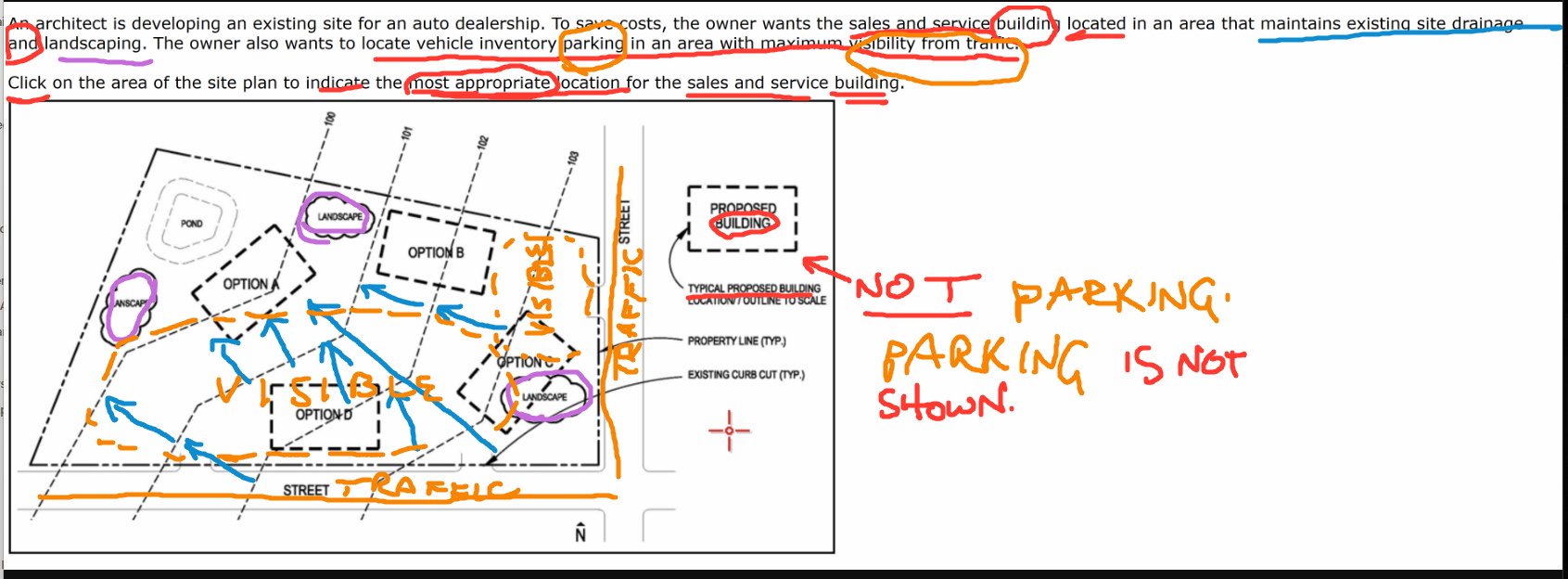
Happy map-reading!
Ralph, the Amber Book Team
Please sign in to leave a comment.
Comments
7 comments