PDD - Practice Exam - Construction Type Question

Can someone explain how the allowable area factor table (Table 506.2) allows 300,000 sq.ft. of building under Type IV construction? In understand that everything else about Type IV HT satisfies the requirements of the client; however, none of the construction types allow for 300,000 sq. ft. of building area except Type I.
Refer to the exhibit.
A large residential development consists of a 300,000-square-foot, five-story, sprinklered (SM) residential building. The client asks an architect to prepare a low-carbon design with an exposed structure.
Which one of the following construction types should the architect use?
| A. | Type V |
| B. | Type IV |
| C. | Type I |
CORRECT RESPONSE
Type IV
Per IBC Table 506.2, this construction type allows for the required building area. Heavy timber construction is Type IV HT, low carbon, and can be left exposed depending on the material depth.
-

Hi Adam,
Allowable area is essentially for the whole building - if the building is single-story it ends up being per floor for the one floor, but fundamentally it's the whole building.
Here's an explanation of how it used to work in IBC 2018 and earlier.
Take a moment and read IBC 506 here. It's the source. IBC 2021 defines Building Area as follows:
AREA, BUILDING. The area included within surrounding exterior walls, or exterior walls and fire walls, exclusive of vent shafts and courts. Areas of the building not provided with surrounding walls shall be included in the building area if such areas are included within the horizontal projection of the roof or floor above.
Fundamentally, a good half of the ARE's questions are at least in part a professional vocabulary quiz. This is definitely one of them.
The fun thing is you can really get to the answer here more or less without doing those calculations - Type I construction is fireproof and fire-protected, meaning concrete or steel, always with a fire-rated cover. That means the design can't be low-carbon, and can't have an exposed structure (an exposed structural frame). Table 504.4 limits Type V R-2 buildings to no more than 4 stories. Thus, Type IV is your only remaining answer option, and I haven't even used the 300,000sf number - it's extraneous info for this question!
Even without looking up Type V's stories limitation, I'd probably mark Type IV as the answer just because if the question asks you for "low-carbon exposed structure" the answer is going to be Type IV 95% of the time, and I'd rather bank the time it would take me to confirm that choice for other questions.
Best,
Ralph, the Amber Book Team -
My colleague at AB had a further note that is worth keeping in mind:
People always miss the "per story" clarification when they're only given the table... and they also don't know or realize that the table gives area factors and that allowable area per formula is larger than that.
It's key that allowable area formulas apply to EACH STORY, not the whole building. So, divide 300,000 SF by 5 stories, and you get 60,000 SF as your area factor which works with multiple construction types, only some of which are low-carbon AND appropriate to be exposed.The each story thing is key. It also applies to mixed-use buildings, but the formula is different.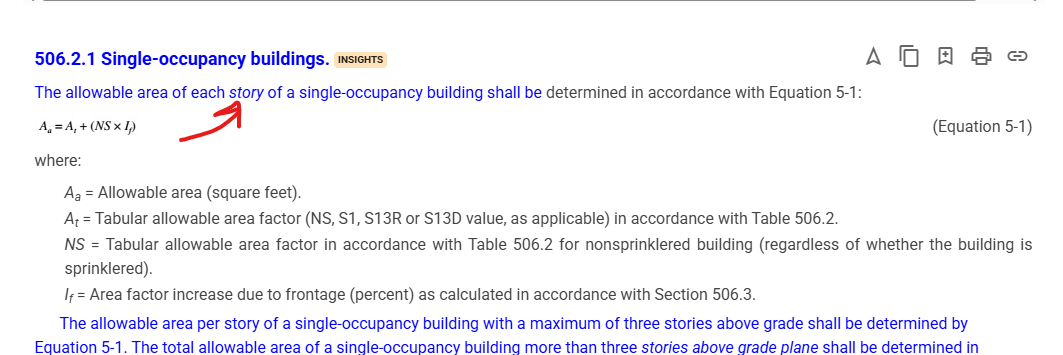 I also want to point something else out, really important for your practice — this table is for allowable area FACTORS. The allowable area for an individual story will always be MORE than the allowable area factor. Like in the formula above:Area-allowable = Area-factor + (Non-sprinklered area factor)x(frontage multiplier)So, you're building will always be bigger than just the factor listed in the table. That's not critical to answering this question, but you should tuck that knowledge away.
Best,
Ralph, the Amber Book Team


Please sign in to leave a comment.
Comments
5 comments