Structure Calculations Questions from ARE 4.0 Handbook

Hello!
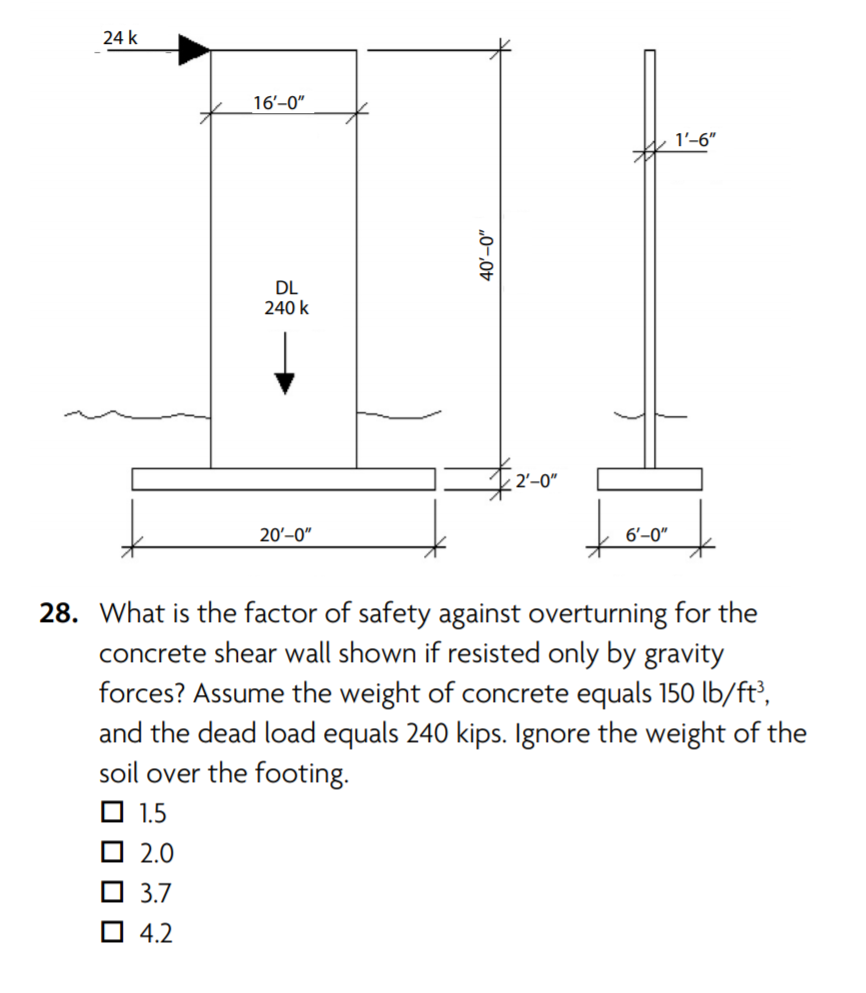
I'm reviewing some of the 4.0 material for PPD. I'm having trouble getting the answers for the following calculation questions. Any advice would be helpful! (Answers are 67 kips and 4.2 for safety factor)
Thank you!
Ashley

-

Hello Ashley,
For the first one, you calculate the load on the column by multiplying the tributary area times the live load to get 6,660 lbs. The formula gets you the load reduction which I got 20lbs for, subtract this from the 66,660 you get 66,640 lbs. 6,640 lbs is about 67 k because 66,640/1000 is 66.64 rounded to 67. 1000lbs=1 kip.
As for the second one, took me much too long but managed to find the answer in ballast. I wouldn't worry too much about this one but I did it anyway because I am getting ready for round 2 on this thing in less than a week and I am also curious. Anyway, first of all, a safety factor I like to think of it as how overdesigned the structure is, for example, a building with a load applied of 10k designed for 10k has a safety factor of 1.0 but if instead it were designed for 20k but having the same 10k load it would be 2.0 (20/10..). In these problems, you have to find the applied force and what's resisting it. On ballast page 45-13 there is a diagram that explains this easily, the applied force is equal to the shear (the 24k at the top) times the height to point of overturning in this case the base (so 42'), this comes out to 1,008k (24k * 42ft=1,008k). for the resisting force, the problem states that only the weight of the shear wall is resisting, normally the weight of the soil would be taken into account but for this one no (cuz the problem said so). The calc for this starts with finding the weight of the wall by multiplying its volume (top and bottom portions) by the 150lbs/ft3 which comes out to 180k the additional load of 240k is also resisting it as well. To better picture why, image standing a book upright and pushing it with your finger at the very top, it would fall down since you can easily exert more than the book can resist on its own but if instead you somehow were to attach a 100-pound object at the top (its a magic book that doesn't get crushed or bent) you wouldn't be able to topple it with just a push of a finger. So you add the 180k (weight of wall) and 240k dead load for a total of 420k, then multiply this by 1/2 the base depth (10ft) because it's the reverse of the shear force in a way and the gravity force acts in the center of the mass. After all this, you get a total of 4200k, to find the safety factor simply divide 4200k by 1,008k and you get 4.167 rounded to 4.2. Wordy but simple I guess, sketch below in case my rumbling didn't make that much sense... (did it on MS paint to mimic the whiteboard)
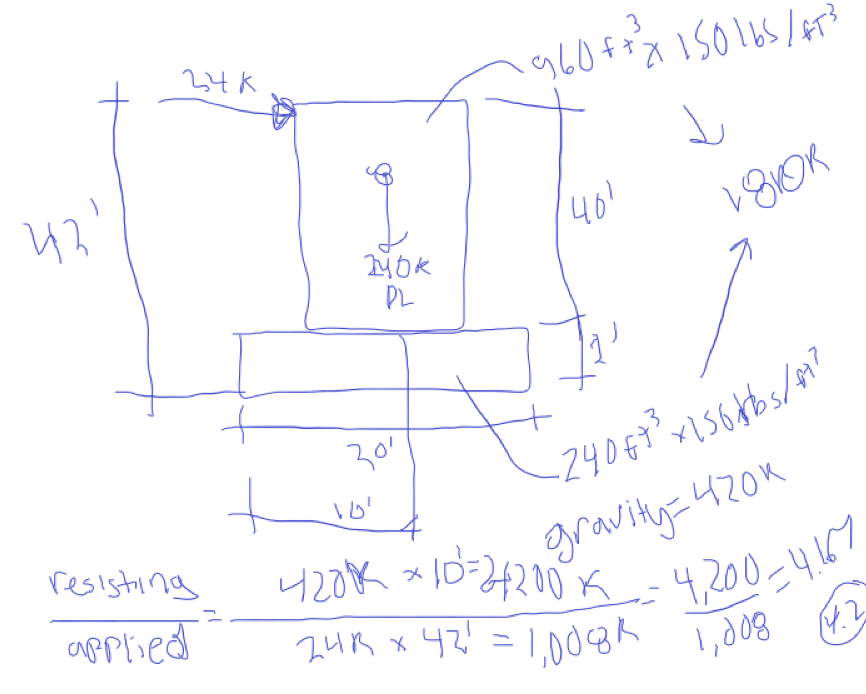
As to why the very bottom is the point of overturning for the 24k force... simply imagine the book example, the first part to move would be the bottom of the book not a middle portion of it, if this were a foundation for a building it would be at the point where earth meets the foundation, this is the point of maximum base shear. Important for earthquakes and in general and is one of the reason why foundations need an anchor bolt at this point or a bolted steel plate if we are talking steel and so on...
-

I'd advise that if you saw something like #28 on the actual exam, that it is a great example of a problem that you should SKIP. If it involves at least 3 math steps and you aren't sure how to do, don't waste time on the actual exam trying to figure it out. Spend the 5-10 min you'd work on it answering 2-5 other questions correctly.
If it were one step - they were asking for the moment (M= force x area) arm - 24k x 40' - then I'd do it, but otherwise it's a question designed to test your ability to skip it.
Question #6 is fairly simple and you should be able to do that fairly quickly.
Also, using 4.0 materials isn't a good idea. The exam was different content and a different format. You are spending a lot of time and energy on the exams, buy the current books and resources you need.
Hope this helps!
Rebekka O'Melia, B.Arch, M. Ed, Registered Architect, NCARB, Step Up ARE Coaching
-

I agree with Rebekka. Many people do not realize time has value: Time is money.
In our time, everyone is so busy. If anything can help people save time, it has a huge market.
That is one of the reasons I wrote my ARE 5.0 exam prep books: people should be able to pass the ARE 5.0 exams with minimum time and effort by avoiding common pitfalls, and spend time on other valuable things.
Gang Chen, Author, Architect, LEED AP BD+C (GreenExamEducation.com)
Please sign in to leave a comment.
Comments
4 comments