Clarification between Overhead multiplier, Net Multiplier, and Break-Even Multiplier

Can someone please clarify the difference between the OH multiplier, net multiplier, and the break-even multiplier and if their relationships, if any?
I understand that the OH multiplier accounts for some of the firm's costs in an employee's billable rate, but I'm confused if the OH is also the Net multiplier. Then the break even multiplier gets you the number if the firm were to make $0, but would that break-even multiplier also account for OH items?
-

For ease of visualizing, let's assume that our firm pays its architect a generous $100 per hour.

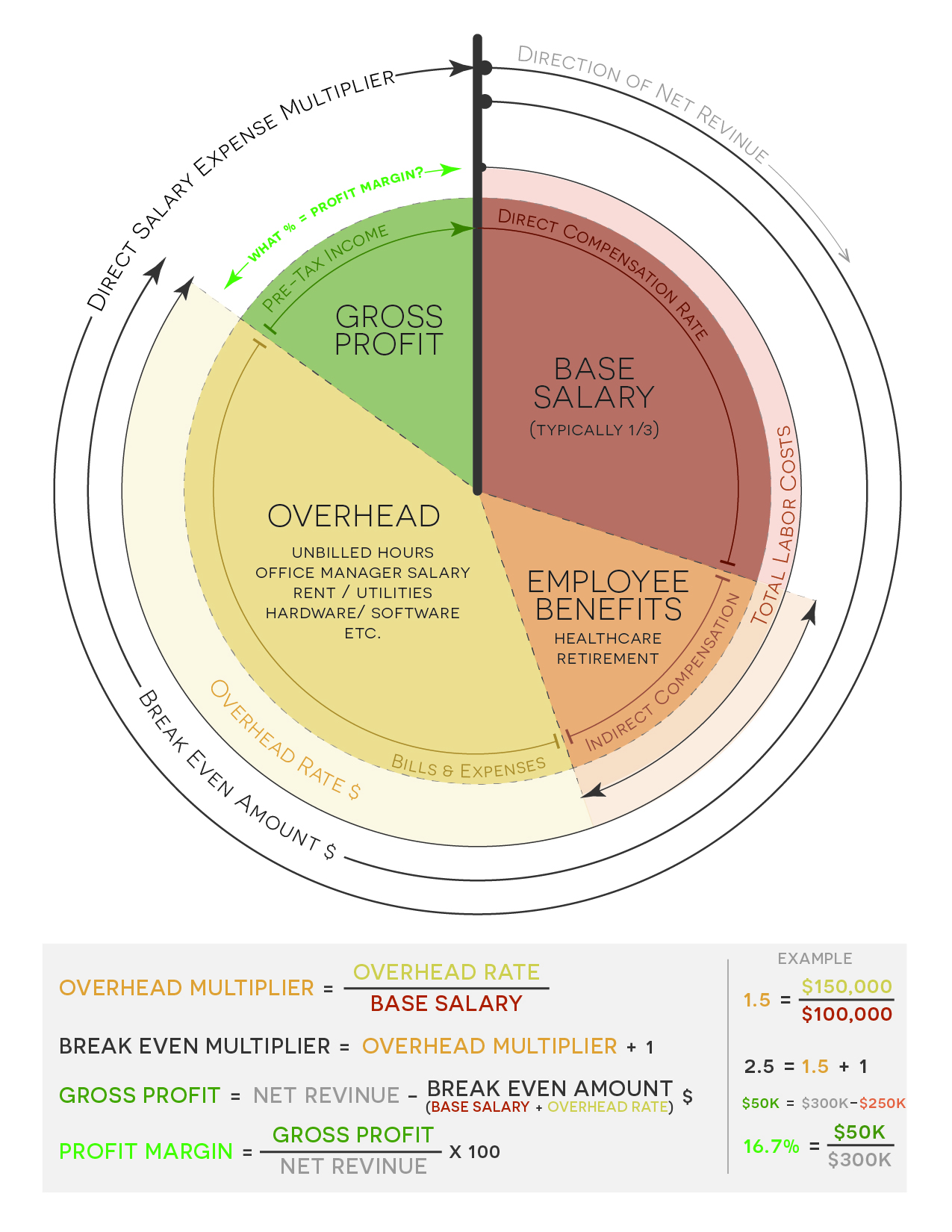
Overhead rate: If our firm spends $150 on non-billable expenses (like AIA conferences) for every $100 it spends on staff salaries for billable client work, than we say that our overhead rate is 1.5 (pretty typical for a healthy firm)
Break-even rate: In the example above, for every $100 we pay in direct (billable time) salary, we need to charge the client $250 to cover both the $100 staff salary and the $150 overhead. We then derive a break even rate of 2.5. That means that for every salary dollar we pay for our architect's billable time, we have to charge 2.5 dollars just to break-even (this is still before we add more to the client bill to account for profit). Break-even rate always equals Overhead rate + 1.0.
Net multiplier: If we charge the client $300 for the $100 we paid our architect, our net multiplier is 3.0 (also typical for a firm). This allows for us to pay our architect $100 for the work, to pay the $150 for overhead (things like AIA conference attendance), and leaves us with $50 left over for profit. -
These two terms are the same thing. But net multiplier is not a real term outside of this exam. know that in ALL of the accounting profession, this difference is only a "thing" in our world. It's a distinction without a difference. In fact, if you google "Direct Salary Expense Multiplier vs Net Multiplier" THIS VERY THREAD HERE IS THE TOP RESULT THAT COMES UP!!!!!
Think about that. Of all the professional services that charge by the hour--lawyers, engineers, researchers, marketers, consultants of all stripes, PLUS the accountants that service them--this is only a question in those studying for the architecture licensing exam?
-

Great info, checkout this video. Enjoy!
-

Does the "Average Billing Rate" include the Net Multiplier?
From my understanding you calculate your Billing Rate by multiplying your "Hourly Rate" by your "Net Multiplier" (i.e. $30 x 3.0 = $90). And you acquire your "average" by averaging all of your Billing Rates together. However, in the PjM practice exam there is a question that requires you to multiply the Net Multiplier by the "Average Billing Rate"...(this seems very counter intuitive)
-
Thank you Michael! I really appreciate your help.
I tried pasting a screen shot, but it got stuck on pending approval.
So, If you have the time, It's Question 7, on page 6 : https://www.ncarb.org/sites/default/files/ARE-Practice-Exam-Project-Management.pdf
-

The answer to that question is incorrect and you're on the right track - you shouldn't multiply a billing rate by a net multiplier because that multiplication has already been done - billing rates are hourly rates x net multiplier.
This question should be adjusted to refer to $50 as the average hourly rate, not billable rate.
Chris Hopstock RA
Black Spectacles
ARE Community -
Citrillion I agree with Michael that these two terms are interchangeable. An interesting quirk about AHPP is that each chapter has its own author (they're listed at the beginning of each chapter) - so sometimes, different terms are used for the same thing.
Chris Hopstock RA
Black Spectacles
ARE Community -
That’s an elegant graphic, jberry. Nice work. Looks accurate to me. Know that I have found that those who memorize formulas related to firm financials don’t have the same record of success as those who put those relatively straight forward mathematical relationships into sentences. “The break even multiple is the multiplier of the architect’s base salary where, were the firm to charge only that multiplier of base salary, the firm would pay for the architect’s salary plus the money it spent sending the architect to the AIA conference.”—Michael Ermann, Amber Book creator
-

@jberry365
I think some of these terms are getting mixed up. I think you are using two different terms to mean the same thing. I think 'overhead multiplier' and 'overhead rate' are the same thing. The overhead rate equals total indirect expenses / total direct labor. The breakeven rate equals the overhead rate +1. There is no 'overhead multiplier' (at least as it concerns the AHPP).
Instead of:
Overhead Rate = Indirect Expense / Total Direct Labor
You are saying:
Overhead Multiplier = Overhead Rate / Base Salary
The terms are related, but not the same.
I also think you are confusing direct labor with base salary. They are different. Direct labor is the same as 'direct salary' not 'base salary' and it is how much time is charged to a project (AHPP p.410 Glossary of Key Accounting Terminology). Direct labor (salary) is viewed from the employers perpsective. Base salary is how much money an employee is paid by his/her employer and is seen from the employees perspective. Direct labor is a category of cost in accounting, while base salary is a component of an employee's pay.




Please sign in to leave a comment.
Comments
28 comments