Transmission Loss

Hi,
Just when I thought I was understanding this topic, another confusing response on a practice quiz..
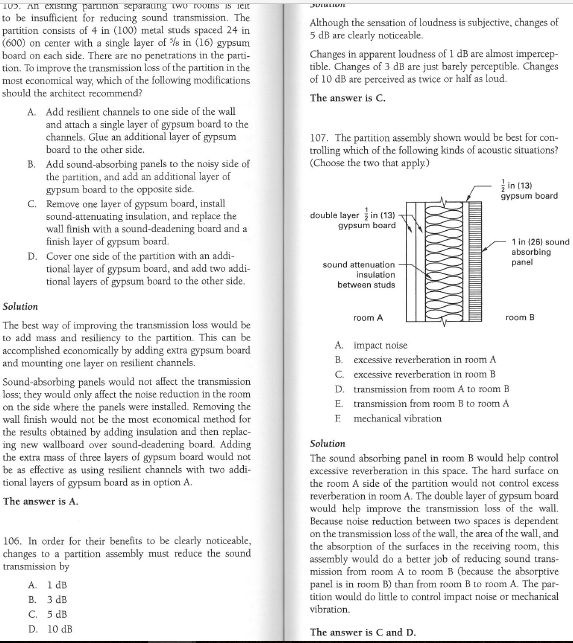
My question is whether having sound absorbing panels on the 'receiving' side of a wall assembly located against a noisy room, helps increase the transmission loss of a wall assembly, or not.
In the attached sample problems, the explanation for question #105 states that adding sound absorbing panels on the noisy side would NOT affect transmission loss.
In the explanation for question #107, the explanation states that having absorption panels on the receiving side (so side B in this case) would help in increasing the transmission loss of the assembly.
Any thoughts would be appreciated.
-

Good question. I think this will help.
Noise reduction is dependant on the transmission loss of the barrier, area, and absorption surfaces in the receiving room. The mass of the barrier that is less stiff will perform better than the one that is stiff thus applying gyp board on resilient channels @24" o.c.makes it less stiff than applying (2) layers of gyp board.
The goal of a high STC rated partition is to decrease the amount of sound transmission through the partition. The following five variables can have an impact on the ability of the partition to retard the sound transmission.
Mass: Increasing the mass of a partition increases the amount of material airborne sound waves must penetrate to reach the adjoining room and can be accomplished by installing multiple layers of gypsum board.
Stiffness: Decreasing the stiffness of a partition will increase the amount of sound transmission loss. For this reason metal
studs outperform wood studs, and framing that is 24" o.c. outperforms framing that is 16" o.c.Damping: Damping, or the ability to dissipate the vibrational energy produced by soundwaves, reduces the amount of energy to pass through the partition.
Cavity Depth: Increasing the depth of the cavity of the partition can increase the amount of sound transmission loss, especially when the cavity is filled with acoustical insulation.
Cavity Absorption: the thickness of sound-absorbing material such as fiberglass or mineral fiber insulation in the cavity of a
partition will increase the amount of sound transmission loss. The thickness of the insulation has a greater effect on sound transmission loss than the density.Notice the STC ratings increase on Page 15. Note: RC-1 = Resilient channel
-
Thank you! This is very helpful. I’ve read over this information a few times however the explanations on the practice quizzes can be confusing and conflicting, I wish there were stricter guidelines on what third party materials can publish so test takers aren’t wasting time researching what the explanations are trying to say.
I did have one clarifying question on your notes above, for the stiffer studs, wouldn’t wood studs technically be less stiff than metal?
Thanks again,
Jenn

Please sign in to leave a comment.
Comments
3 comments